
Divorce in the U.S. has fallen substantially over the past several decades. But where you live still makes a big difference.
In 2024, the U.S. refined divorce rate was 14.2 divorces per 1,000 married women. But state-level rates varied considerably, from 20.7 in Oklahoma to 10.0 in Maine. That means Oklahoma’s rate was more than twice Maine’s.
So, which states have the highest divorce rates in the U.S.?
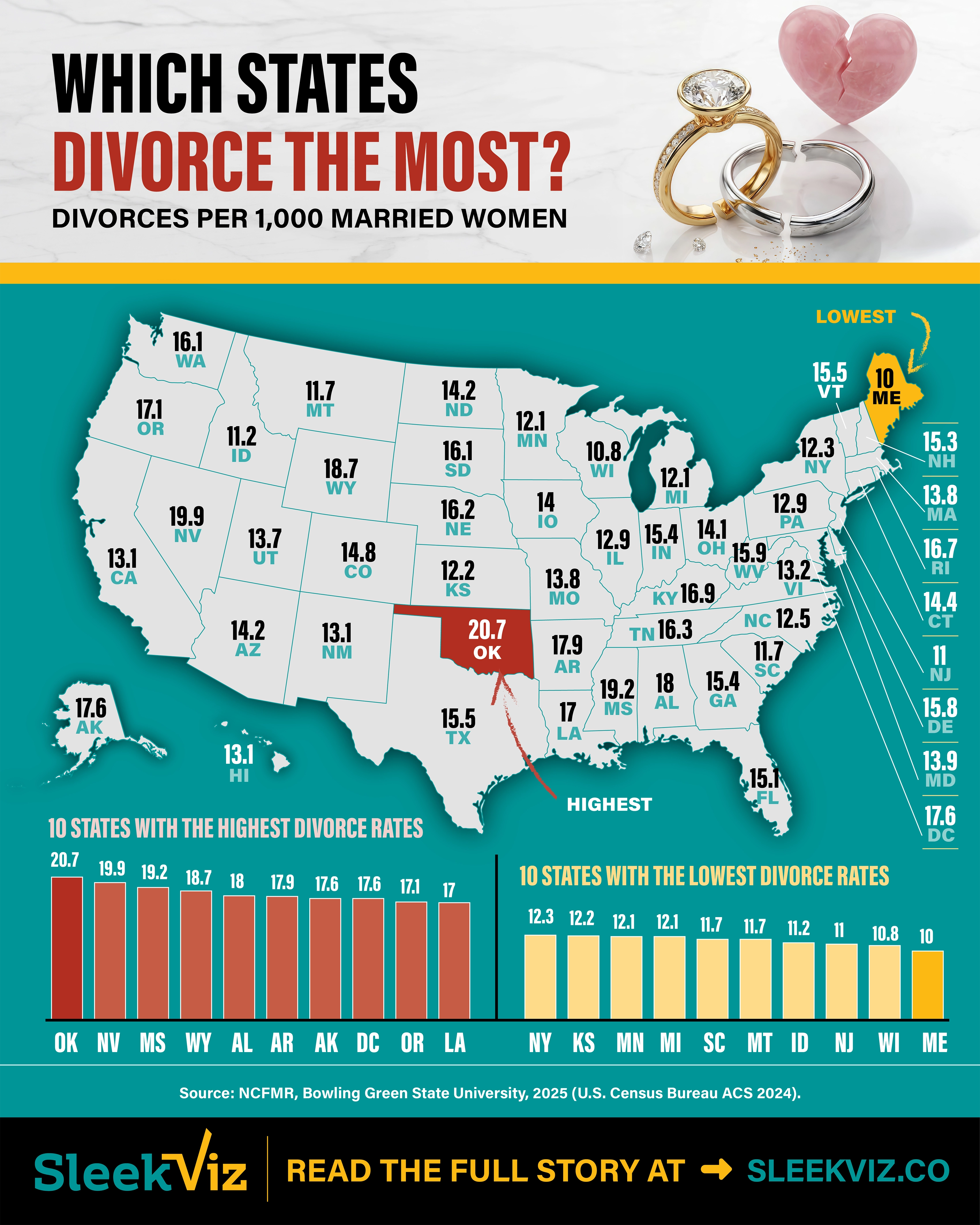
Which states divorce the most?
According to the National Center for Family & Marriage Research (NCFMR), Oklahoma had the highest refined divorce rate in 2024, followed by Nevada and Mississippi.
The 10 states with the highest rates were:
Divorces per 1,000 married women
No Data Found
The national average was 14.2.
At the other end of the ranking, Maine had the lowest refined divorce rate at 10.0, followed by Wisconsin at 10.8 and New Jersey at 11.0.
The states with the lowest divorce rates
The 10 lowest-rate states and jurisdictions were:
Divorces per 1,000 married women
No Data Found
The ranking includes the District of Columbia, which is why the full comparison contains 51 areas rather than just the 50 states.
Divorce rates show a clear regional pattern
The differences aren’t spread randomly across the country.
The South has the strongest concentration of states with higher divorce rates. According to NCFMR’s quartile analysis, 47% of Southern states were in the highest divorce-rate quartile, while none were in the lowest quartile.
The Midwest shows almost the opposite pattern. No Midwestern state appeared in the highest quartile, while 42% were in the lowest quartile.
The Northeast also had a relatively large concentration of lower-rate states, with 44% in the bottom quartile.
The West was more divided. States such as Nevada, Wyoming, Oregon and Alaska were among the higher-rate states, while Idaho and Montana were among the lower-rate states.
Why are divorce rates higher in some states?
There isn’t one explanation for why divorce rates differ so much from state to state.
Researchers point to several factors that can be associated with divorce, including age at marriage, economic conditions and demographic differences.
Oklahoma, for example, has a relatively young median age at first marriage, and younger marriages have been associated with higher divorce risk nationally.
Economic instability may also play a role. Financial stress and job instability have been associated with marital dissolution, and several of the states with the highest divorce rates, including Oklahoma, Arkansas and Mississippi, also have relatively high levels of poverty.
The brief also points to a longstanding pattern sometimes described as the “red-state divorce paradox,” in which some socially and religiously conservative states have historically recorded relatively high divorce rates despite stronger cultural emphasis on marriage.
These factors should not be interpreted as proving that any single characteristic causes higher divorce rates in a particular state. State-level differences reflect a combination of demographic, economic and social factors.
Divorce in America is near a 50-year low
While the differences between states are striking, the broader U.S. trend is just as notable.
The refined divorce rate has fallen substantially since its 1980 peak.
Refined divorce rate
No Data Found
The 2024 rate was about 37% below the 1980 peak.
One explanation researchers point to is a change in who gets married. Marriage has become less common among some groups with lower levels of education, while marriage has increasingly become concentrated among people with higher education and greater financial stability, groups that historically have had lower divorce risk.
People are also marrying later than they did decades ago. The median age at first marriage is now roughly 30 for men and 28–29 for women, and later marriage is associated with more stable marriages.
How is the divorce rate calculated?
There are several ways to measure divorce, and they don’t produce exactly the same results.
This analysis uses the refined divorce rate, which measures the number of women divorcing per 1,000 married women aged 15 and older.
That distinction matters.
A simple crude divorce rate measures divorces per 1,000 people in the total population. But states have very different proportions of married people, so comparing crude rates can make state-to-state comparisons less precise.
The NCFMR refined measure instead focuses on the married population and uses U.S. Census Bureau American Community Survey data. The 2024 analysis covers all 50 states and the District of Columbia.
For comparison, CDC/National Center for Health Statistics data for 2023 show a similar group of states near the top, although the rankings differ. The CDC measure also has gaps because five states did not report divorce data to the NCHS for that year.
For this reason, the refined NCFMR rate is the measure used throughout this comparison.
The bottom line
Divorce has become less common in the United States compared with its peak decades ago, but the national average doesn’t tell the whole story.
In 2024, the refined divorce rate ranged from 20.7 in Oklahoma to 10.0 in Maine.
The pattern also has a strong geographic component, with Southern states more concentrated toward the higher end and Midwestern and Northeastern states more represented toward the lower end.
But a state’s divorce rate is not a simple measure of how successful or unsuccessful marriages are. It reflects differences in demographics, marriage patterns, economic conditions and other factors that vary across the country.
Methodology
This article uses the 2024 refined divorce rate from the National Center for Family & Marriage Research (NCFMR), based on U.S. Census Bureau American Community Survey 1-year estimates, Tables B12001 and B12503.
The rate represents women divorcing per 1,000 married women aged 15 and older.
Figures are the latest available as of September 24, 2026.
Sources:
National Center for Family & Marriage Research, Bowling Green State University; U.S. Census Bureau American Community Survey; CDC/National Center for Health Statistics.
