
Where does your state rank? A new WalletHub analysis scores all 50 states across 30 measures related to emotional and physical well-being, work, and community.
What makes a state a happy place to live?
It isn’t just sunshine, income or having more free time. Happiness is influenced by a combination of factors, including physical and emotional well-being, financial security, work conditions, relationships, leisure time and the environment around us.
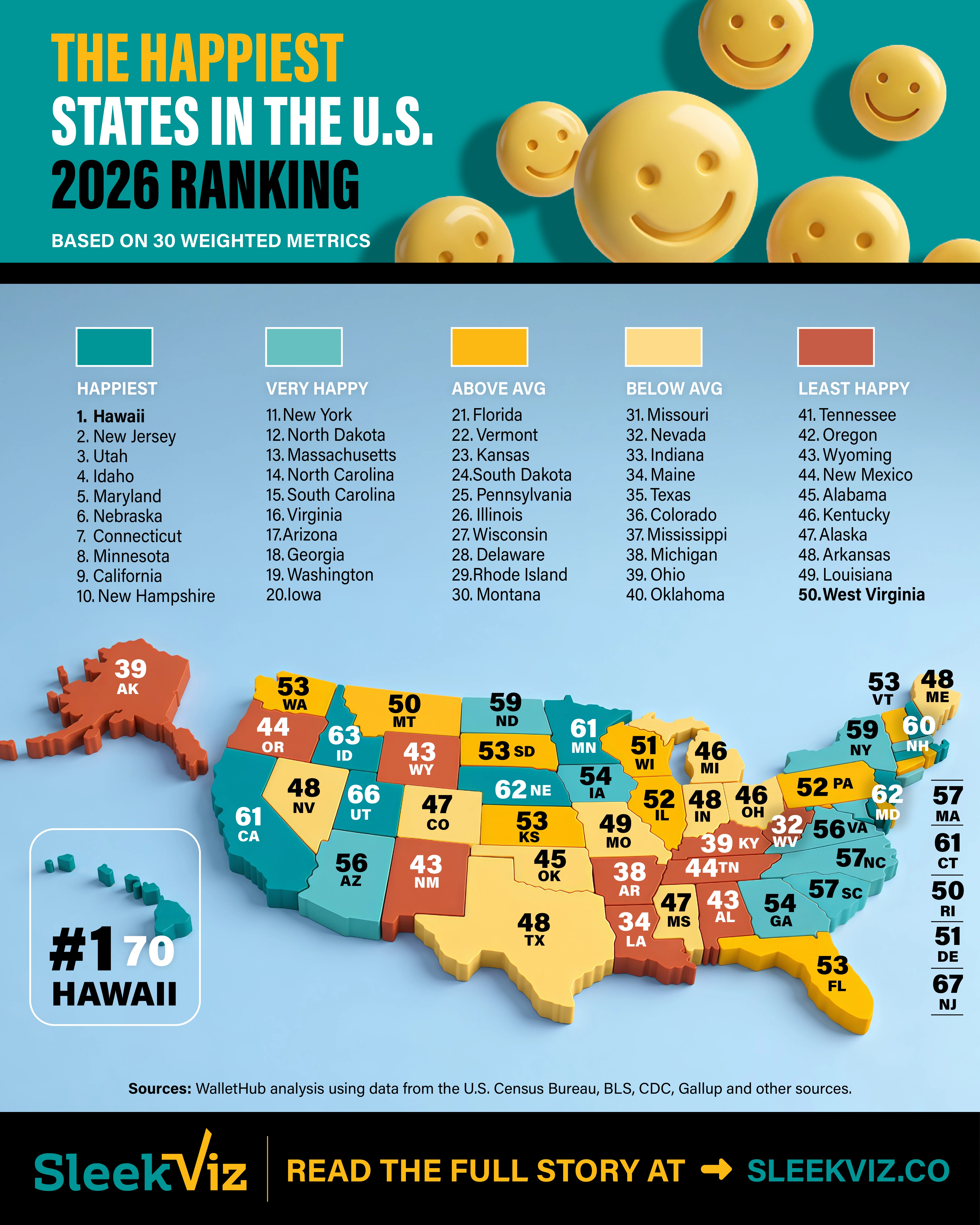
WalletHub’s 2026 analysis attempts to capture that broader picture by comparing all 50 U.S. states across 30 weighted metrics. The measures are grouped into three dimensions: Emotional & Physical Well-Being, Work Environment, and Community & Environment. Each metric is scored on a 100-point scale, with the final ranking based on a weighted average.
And the result isn’t necessarily what you might expect.
Hawaii takes the top spot
Hawaii ranks No. 1, with a total score of 69.53.
The state ranks second nationally for emotional and physical well-being and fifth for work environment. WalletHub also points to Hawaii’s high life satisfaction, relatively low depression rate, strong physical health and favorable economic conditions as factors contributing to its position.
But Hawaii isn’t alone at the top.
New Jersey ranks second, followed by Utah, Idaho and Maryland.
Utah is particularly notable because it ranks No. 1 in both Work Environment and Community & Environment, despite placing 17th in Emotional & Physical Well-Being.
The 15 highest-ranked states
| RANK | STATE | SCORE |
|---|---|---|
| 1 | Hawaii | 69.53 |
| 2 | New Jersey | 67.09 |
| 3 | Utah | 66.45 |
| 4 | Idaho | 62.59 |
| 5 | Maryland | 62.01 |
| 6 | Nebraska | 61.81 |
| 7 | Connecticut | 61.38 |
| 8 | Minnesota | 60.91 |
| 9 | California | 60.58 |
| 10 | New Hampshire | 59.89 |
| 11 | New York | 59.38 |
| 12 | North Dakota | 59.38 |
| 13 | Massachusetts | 57.26 |
| 14 | North Carolina | 56.77 |
| 15 | South Carolina | 56.65 |
Notice something interesting: New York makes the top 15 despite ranking only 34th in Work Environment and 39th in Community & Environment. Its third-place ranking in Emotional & Physical Well-Being helps pull its overall score upward.
What about the middle?
The middle of the ranking is surprisingly compressed.
Virginia sits at No. 16 with a score of 56.08, while South Carolina at No. 15 scores 56.65. At the other end of the middle range, Montana is No. 30 with 49.51.
That means a relatively small difference in overall score can translate into several places in the ranking.
The states ranked 16–30 are:
Virginia, Arizona, Georgia, Washington, Iowa, Florida, Vermont, Kansas, South Dakota, Pennsylvania, Illinois, Wisconsin, Delaware, Rhode Island and Montana.
The lower end of the ranking
At the bottom, West Virginia ranks No. 50, with a score of 31.88.
Louisiana, Arkansas, Alabama and Kentucky complete the bottom five.
WalletHub’s data show substantial differences between states on individual measures. For example, New Jersey has the nation’s lowest share of adults reporting depression, while West Virginia has the highest. There are also large differences in measures such as suicide rates, work hours, income growth and volunteer participation.
That doesn’t mean a state’s residents are simply “happy” or “unhappy.” The ranking is an index built from selected indicators that WalletHub associates with conditions related to happiness.
What does the ranking actually measure?
WalletHub’s three dimensions cover a surprisingly broad range of life:
Emotional & Physical Well-Being
- Depression
- Life expectancy
- Suicide rate
- Career well-being
- Financial anxiety
- Physical health
- Economic security
Work Environment
- Unemployment
- Job security
- Work hours
- Commute time
- Income growth
- Work-related stress
Community & Environment
- Volunteerism
- Weather
- Leisure time
- Safety
- Separation and divorce rates
The methodology assigns different weights to the individual metrics. For example, ideal weather receives a triple weight within the Community & Environment dimension, while average leisure time receives a double weight.
Happiness is more than a number
The ranking is ultimately a snapshot of how different states perform across a particular set of indicators.
It doesn’t measure every dimension of happiness, and it doesn’t mean that everyone living in a high-ranked state is happier than everyone living somewhere else.
But it does provide an interesting way to examine the conditions that surround well-being across the country.
So, where does your state rank?
Source: WalletHub, Happiest States in America 2026. Data collected as of August 11, 2026. Scores and rankings are based on WalletHub’s methodology and 30 weighted metrics.
