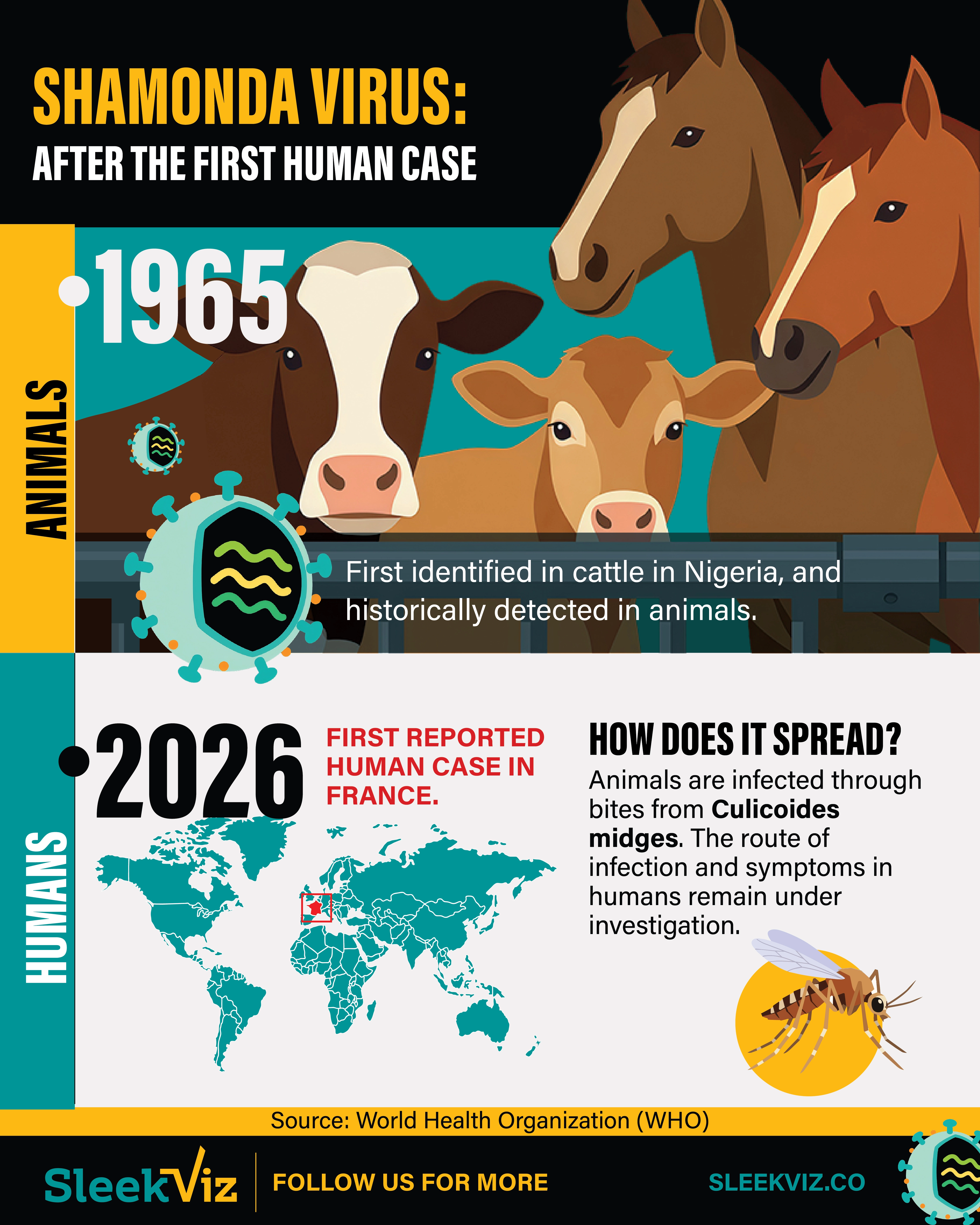
A virus known to scientists for decades has made headlines after France reported the first documented human case of Shamonda virus in October 2026. Until now, the virus had been identified in animals, mainly cattle, rather than humans.
What is Shamonda virus?
Shamonda virus belongs to a group of viruses known as Orthobunyavirus. It was first isolated from cattle in Nigeria in 1965 and has since been detected in animals across parts of Africa and Asia. In 2026, it was identified in European livestock for the first time.
The virus primarily affects cattle, but it has also been detected in sheep, goats, horses and alpacas.
How does it spread?
In animals, Shamonda virus is thought to spread through bites from infected Culicoides midges, tiny, fly-like insects. Researchers believe a similar route may explain the first human case in France, but the investigation is still underway.
What happened in the first human case?
French health authorities reported the infection in a severely immunocompromised patient who was being treated for a serious medical condition. The patient experienced neurological complications and died in early October.
Investigators are still determining whether the virus caused or contributed to the patient’s death and how the infection occurred. One case is not enough to establish the full range of symptoms or the severity of the disease in humans.
Should people be worried?
As of October 23, 2026, French health authorities have identified no evidence of human-to-human transmission or a health risk to the general population. The case is unusual, and scientists are continuing to study how the infection occurred and what it could mean for human health.
There are currently no specific treatments or vaccines for Shamonda virus, according to the World Health Organization (WHO).
For now, the first human case raises important scientific questions, but it does not by itself indicate a wider outbreak among people.
Sources: World Health Organization (WHO) · Santé publique France · European Centre for Disease Prevention and Control (ECDC)