
Mpox and Common Childhood Rashes: A Parent’s Guide to Recognizing Symptoms
By Editorial Team 3 months agoAs a parent, few things can be more concerning than discovering a new rash on your child’s skin. One day it may be a few red spots on the arm. The next day it has spread to the face, hands, or legs. Naturally, questions begin to race through your mind.
Is it eczema? Could it be chickenpox? Is it hand, foot and mouth disease? Or could it be mpox?
Although mpox continues to receive media attention, it remains uncommon in children in the United States. At the same time, conditions such as eczema, viral rashes, impetigo, and hand, foot and mouth disease are seen much more frequently by pediatricians. The challenge is that many skin conditions can look surprisingly similar during their early stages. Red bumps, blisters, crusts, and itchy patches may overlap, making it difficult for parents to know what they are looking at.
This guide explains how mpox compares with several common childhood rashes, what symptoms to watch for, how the virus spreads, and when it is time to contact your child’s healthcare provider. If you are looking for a quick visual summary, our infographic below highlights the key differences between several common childhood skin conditions.
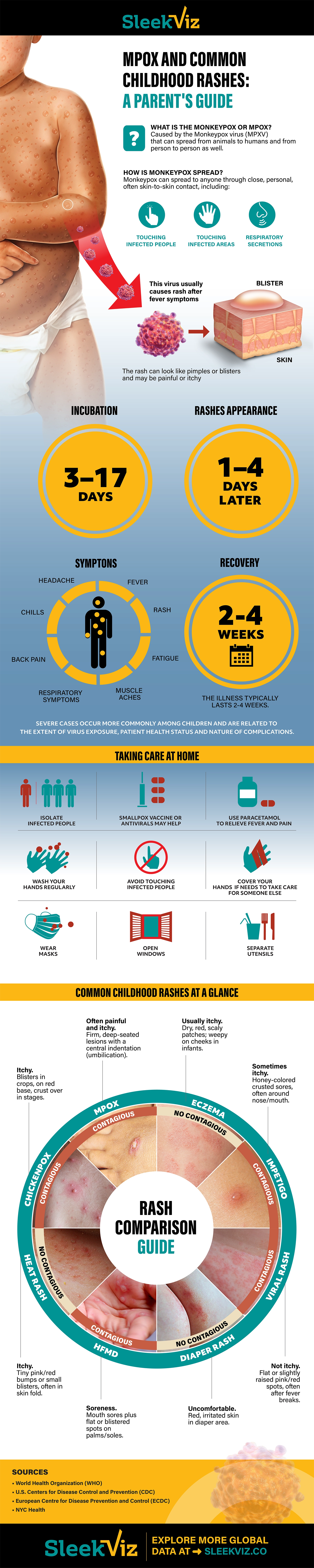
Your download includes: 1 High-Resolution JPG + 1 PDF File
What Is Mpox?
Mpox, formerly known as monkeypox, is a viral illness caused by the monkeypox virus (MPXV), a member of the orthopoxvirus family. While it belongs to the same family as the virus that caused smallpox, mpox is generally less severe.
The virus was first identified in 1958, and human cases have been documented for decades in parts of Central and West Africa. In 2022, mpox gained worldwide attention after outbreaks occurred in many countries where the disease had not previously been common.
Although the World Health Organization ended the global Public Health Emergency of International Concern for mpox in September 2025, the virus has not disappeared. Cases continue to be reported around the world, and public health agencies continue to monitor new outbreaks and provide updated guidance.
Today, health experts describe mpox as an ongoing infectious disease that requires awareness rather than alarm.
How Does Mpox Spread?
Unlike viruses that spread easily through casual contact, mpox usually requires close physical exposure.
A person can become infected through:
- Direct skin-to-skin contact with the rash, blisters, or body fluids of an infected person.
- Contact with contaminated items such as towels, bedding, clothing, or shared personal items.
- Prolonged face-to-face contact involving respiratory secretions.
- Close household contact while caring for someone who is infected.
- Transmission from a pregnant parent to the fetus, or from parent to newborn during or shortly after birth.
Current evidence from the World Health Organization also shows that many recent outbreaks have been driven by close intimate contact, while household transmission remains another important route of spread.
Fortunately, mpox does not spread as easily as illnesses such as measles or chickenpox, which can move rapidly through schools and households.
Simple precautions, including frequent handwashing, avoiding direct contact with an infected person’s rash, cleaning contaminated surfaces, and following public health guidance after exposure, significantly reduce the risk of infection.
sources
- World Health Organization (WHO)
- U.S. Centers for Disease Control and Prevention (CDC)
- European Centre for Disease Prevention and Control (ECDC)
- NYC Health
