
Understanding HRV, VO₂ Max, Sleep Scores, SpO₂, and More
Modern fitness wearables can track hundreds of data points, but collecting data is only half the equation. The real challenge is understanding what those numbers actually mean.
What is a good HRV? How much deep sleep should you get? Is your blood oxygen level normal? And what exactly does VO₂ Max measure? This guide explains the most important health metrics found on devices like the Apple Watch, Garmin, Oura Ring, WHOOP, Samsung Galaxy Ring, Fitbit, and Withings.
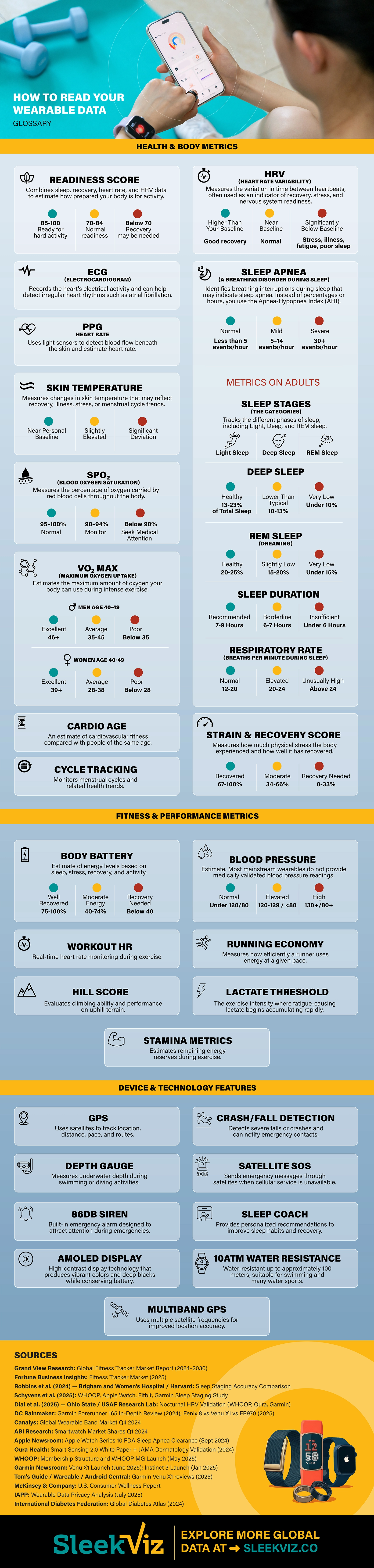
Your download includes: 1 High-Resolution JPG + 1 PDF File
Heart Rate Variability (HRV)
HRV stands for Heart Rate Variability.
It measures the variation in time between heartbeats.
Contrary to what many people think, a perfectly steady heartbeat is not ideal. Greater variability generally reflects a more adaptable nervous system.
Higher HRV often indicates:
- Good recovery
- Lower stress levels
- Better sleep quality
Lower HRV may be associated with:
- Illness
- Fatigue
- Poor sleep
- Increased stress
The most important thing to remember is this:
Compare your HRV to your personal baseline, not someone else’s.
VO₂ Max
VO₂ Max measures the maximum amount of oxygen your body can use during exercise.
It’s one of the strongest indicators of cardiovascular fitness and endurance.
Higher VO₂ Max values are generally linked to:
- Better aerobic fitness
- Improved endurance performance
- Lower cardiovascular risk
Wearables estimate VO₂ Max using heart rate, pace, GPS, and activity data.
Laboratory testing remains the gold standard.
Blood Oxygen (SpO₂)
SpO₂ measures the percentage of oxygen carried by your red blood cells.
General guidelines for healthy adults:
- Normal: 95–100%
- Monitor: 90–94%
- Seek medical attention: Below 90%
Many factors can influence readings, including altitude, movement, and device fit.
Wearables should not be used as medical diagnostic tools.
Sleep Stages Explained
Most wearables divide sleep into three stages:
- Light Sleep
The transition between wakefulness and deeper sleep.
- Deep Sleep
Supports physical recovery, immune function, and tissue repair.
Healthy adults typically spend about 13–23% of total sleep in deep sleep.
- REM Sleep
REM stands for Rapid Eye Movement.
This stage supports:
- Memory consolidation
- Learning
- Emotional regulation
Healthy adults typically spend about 20–25% of total sleep in REM sleep.
Sleep Duration
The Centers for Disease Control and Prevention recommends that most adults aim for seven or more hours of sleep per night.
For many adults, seven to nine hours is considered an optimal target.
Consistently sleeping less than six hours may negatively affect recovery, mood, and long-term health.
Sleep Apnea Detection
Some wearables can estimate the risk of sleep apnea.
These features often monitor:
- Breathing disturbances
- Blood oxygen trends
- Heart rate changes
Sleep apnea severity is measured using the Apnea-Hypopnea Index (AHI):
Normal: Fewer than 5 events per hour
- Mild: 5–14 events per hour
- Moderate: 15–29 events per hour
- Severe: 30 or more events per hour
Only a healthcare professional can diagnose sleep apnea.
Resting Heart Rate
Resting heart rate measures how many times your heart beats per minute while at rest.
General guidelines:
- Athletes: 40–60 beats per minute
- Healthy adults: 60–80 beats per minute
- Elevated: 80–100 beats per minute
Trends matter more than individual readings. A sudden increase in resting heart rate may indicate stress, illness, or insufficient recovery.
Readiness Scores, Body Battery, and Recovery Metrics
Many wearables summarize multiple health signals into a single score.
Examples include:
- Oura Readiness Score
- Garmin Body Battery
- WHOOP Recovery Score
These metrics typically combine:
- Sleep quality
- HRV
- Resting heart rate
- Recent activity
- Skin temperature
Use these scores as guidance rather than strict rules. They’re best suited for identifying long-term trends.
Skin Temperature
Wearables can track changes in skin temperature during sleep.
Rather than focusing on the absolute number, pay attention to deviations from your personal baseline.
Changes may reflect:
- Illness
- Stress
- Recovery status
- Menstrual cycle phases
Blood Pressure
Most consumer wearables do not provide medically validated blood pressure readings.
General adult guidelines are:
- Normal: Below 120/80 mm Hg
- Elevated: 120–129 and below 80 mm Hg
- High: 130/80 mm Hg or higher
Always use a clinically validated blood pressure cuff for diagnosis.
Remember: Trends Matter More Than Single Numbers
One night of poor sleep won’t define your health. One low HRV reading doesn’t necessarily mean you’re overtrained. Wearables are most useful when they help you identify patterns over time.
Ask yourself:
- How do I feel?
- How did I sleep this week?
- Is my resting heart rate changing?
- Is my HRV consistently lower than usual?
The goal isn’t to chase perfect scores, the goal is to build healthier habits. Looking for a device that tracks these metrics?
Read our companion guide: Top Fitness & Health Wearables Compared (2026).
Sources
- American Heart Association: All About Heart Rate (Pulse)
- American Heart Association: Understanding Blood Pressure Readings
- Centers for Disease Control and Prevention: About Sleep
- National Sleep Foundation
- American Academy of Sleep Medicine
- International Diabetes Federation
- Apple product documentation
- Garmin product documentation
- Oura product documentation
- WHOOP product documentation
- Fitbit product documentation
- Withings product documentation
- Peer-reviewed wearable validation studies
