A purchasing power comparison of what $1,000 can buy in 32 countries
How far does $1,000 really go around the world? It depends on where you live.
A $1,000 monthly income can be difficult to live on in cities such as New York, Toronto, Zurich, Sydney, or London. In lower-cost countries, however, the same amount can represent several times the purchasing power it has in the United States.
This comparison looks at what $1,000 per month can mean in different countries, using purchasing power parity (PPP), local wage data, and estimated living expenses to put the differences into perspective.
The result is striking: the same nominal income can support dramatically different standards of living depending on local prices and wages.

Your download includes: 1 High-Resolution JPG + 1 PDF File
Where Does $1,000 Go the Furthest?
Among the countries in our comparison, Pakistan, Bangladesh, and Egypt rank in the highest purchasing-power tier.
Using the PPP-adjusted comparison, $1,000 has an estimated real purchasing power equivalent of approximately:
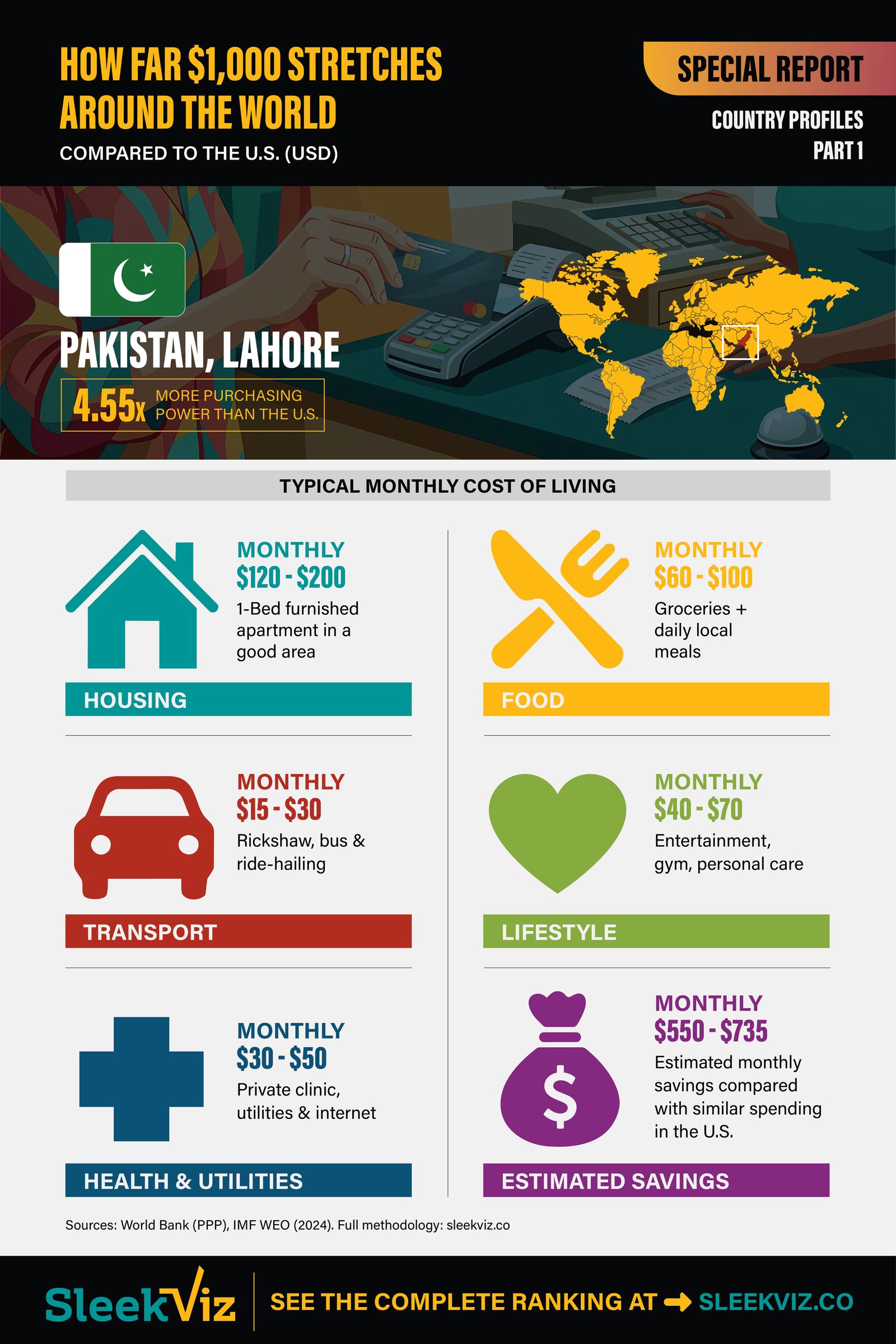
- $4,550 in Pakistan
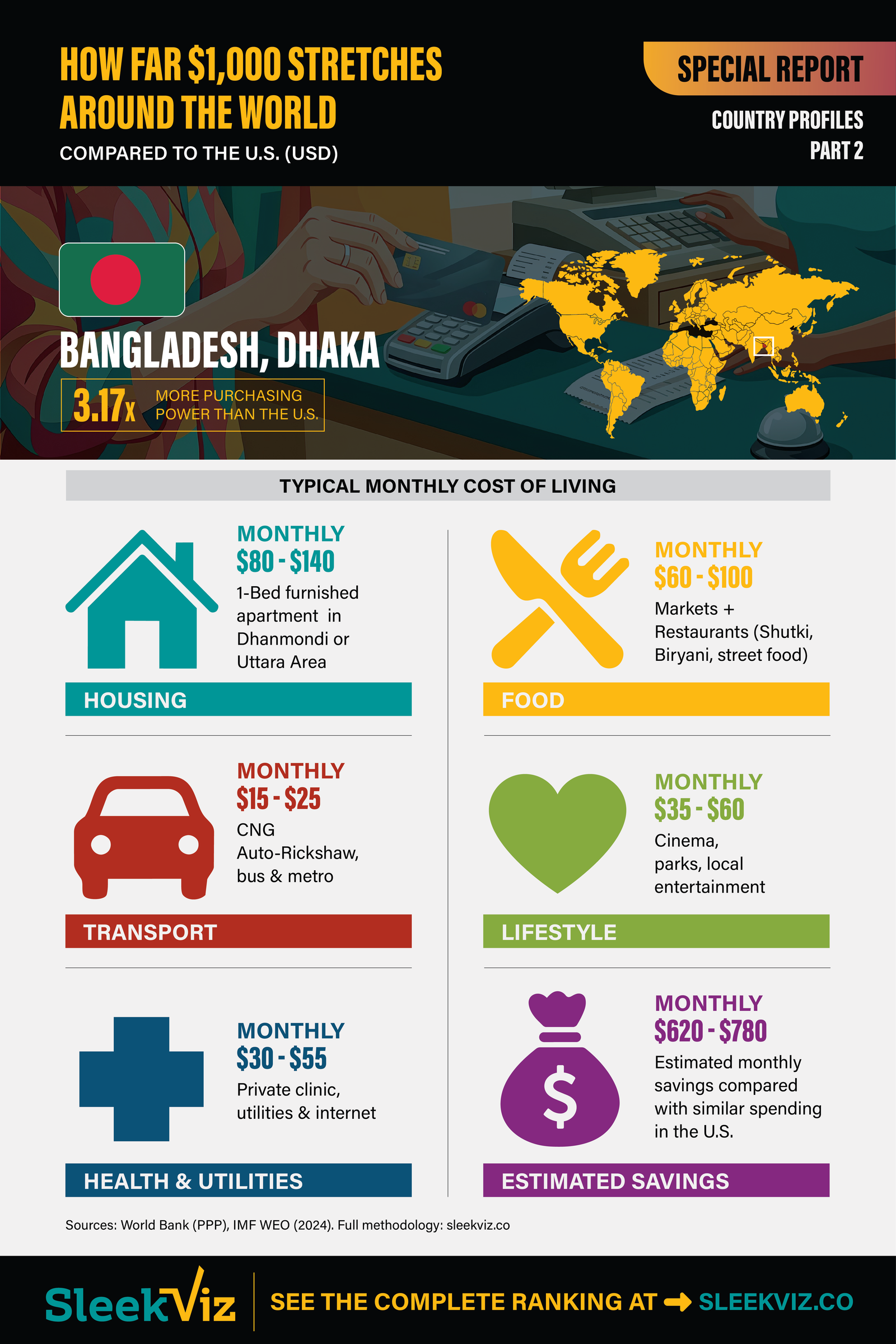
- $3,170 in Bangladesh
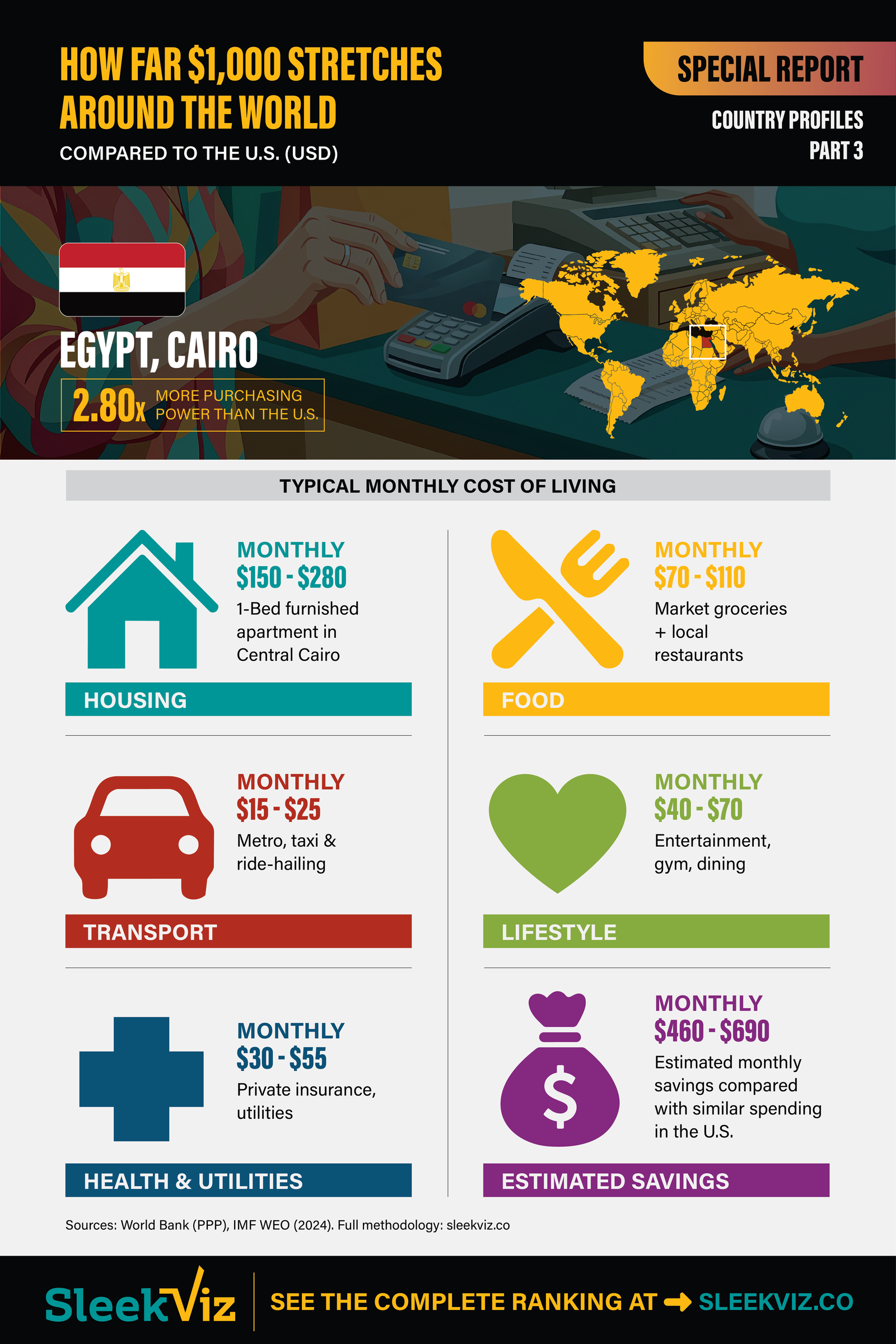
- $2,800 in Egypt
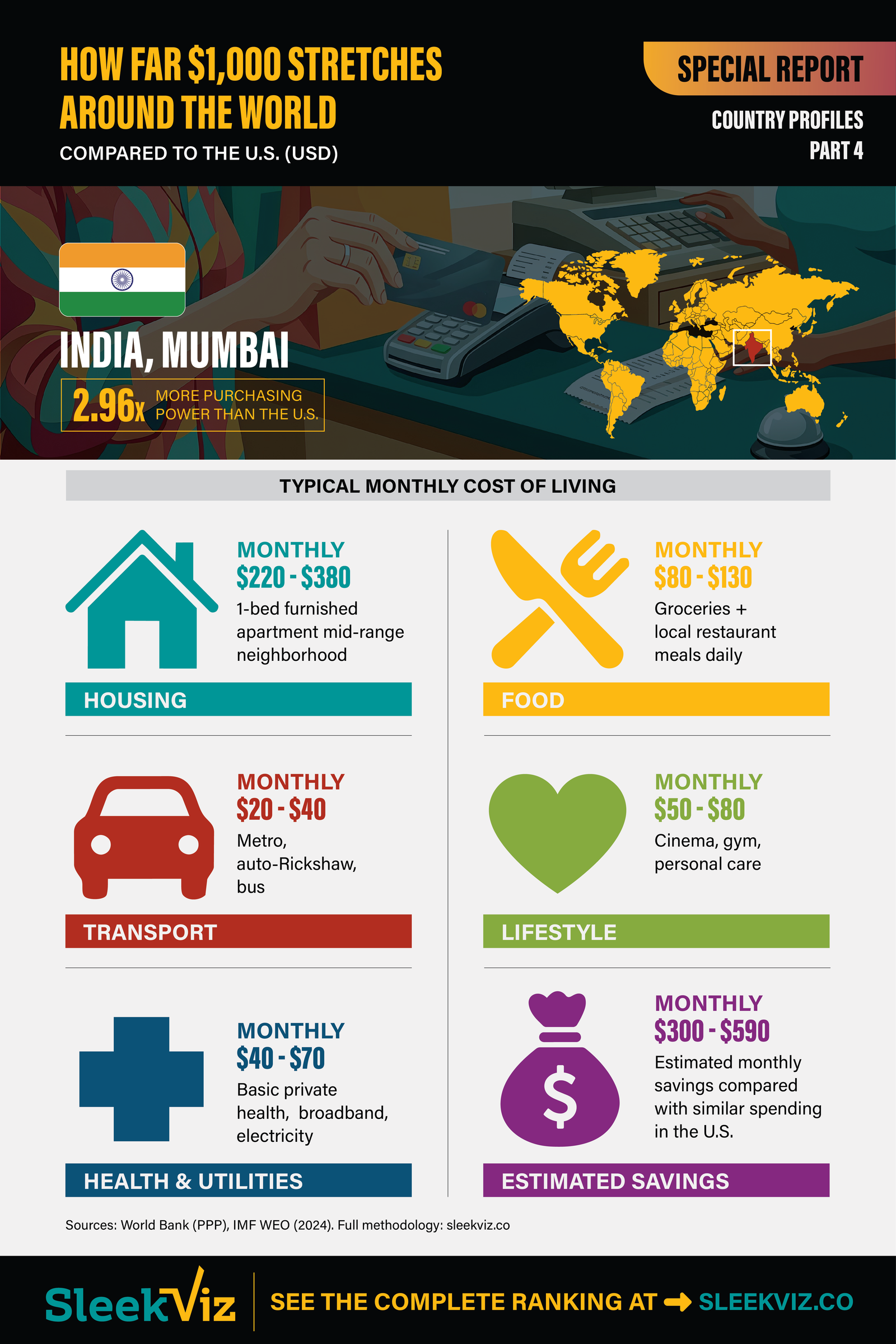
- $2,960 in India
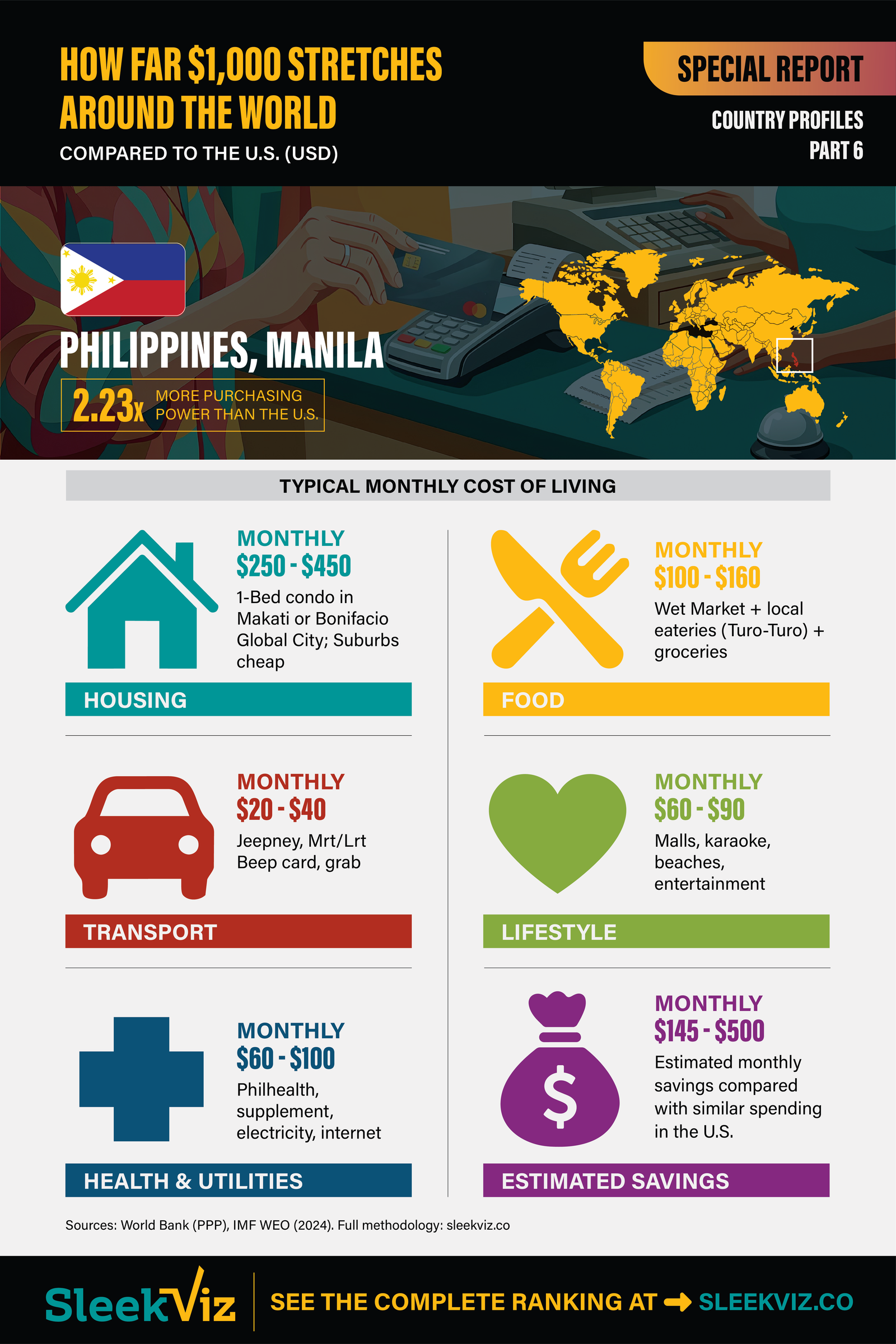
- $2,230 in the Philippines
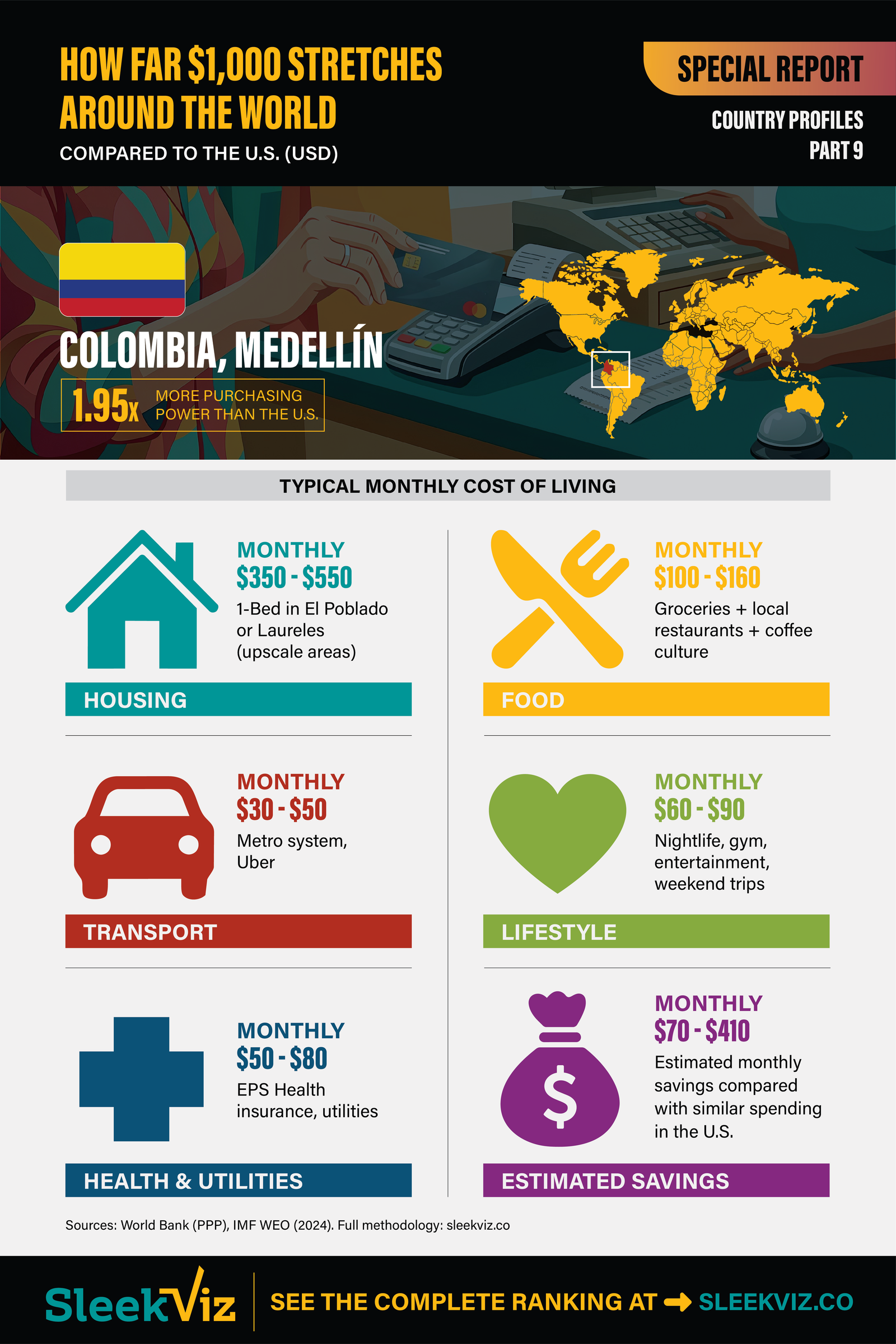
- $1,950 in Colombia
At the other end of the comparison, $1,000 has considerably less purchasing power in higher-cost economies:
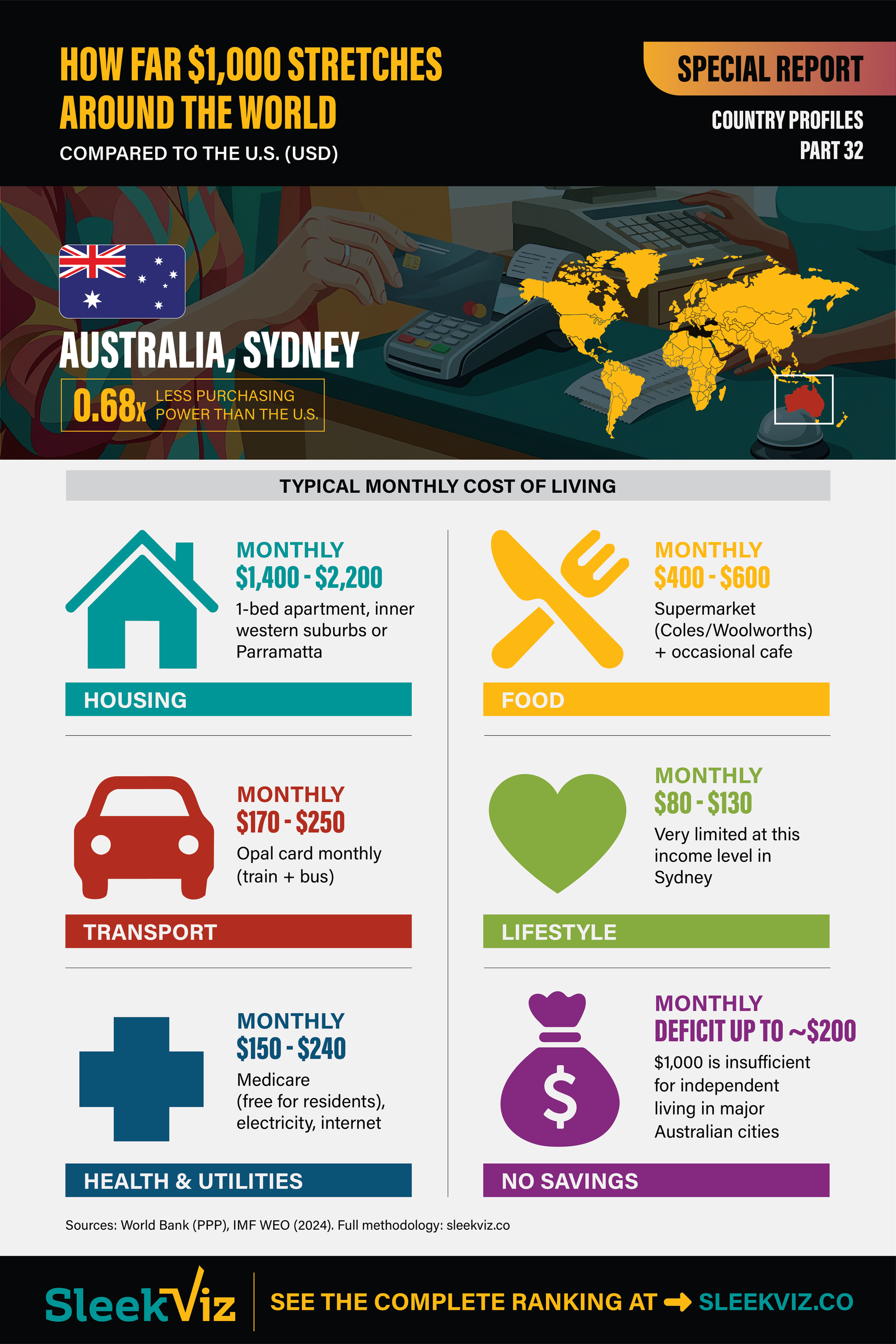
- $680 in Australia
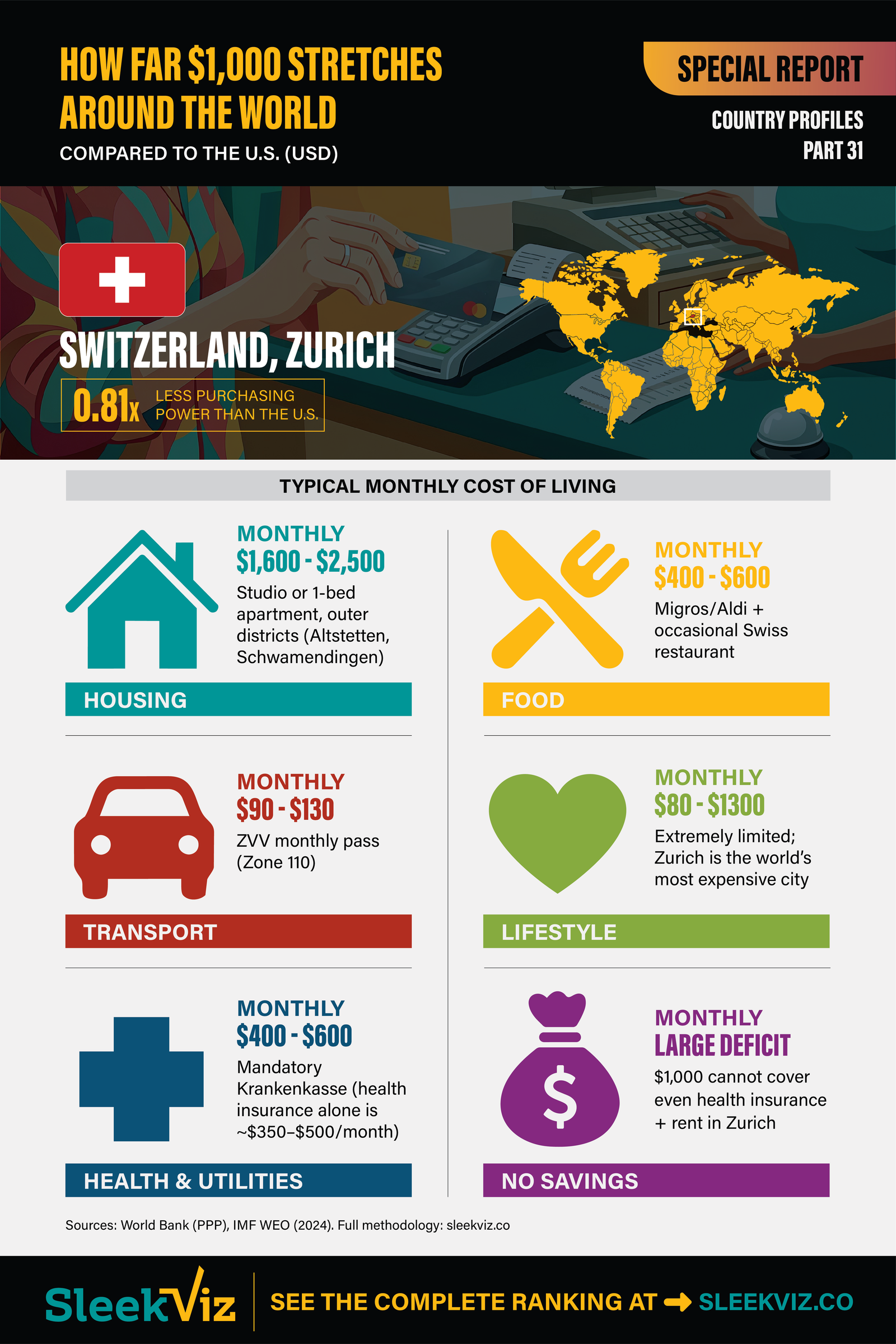
- $810 in Switzerland
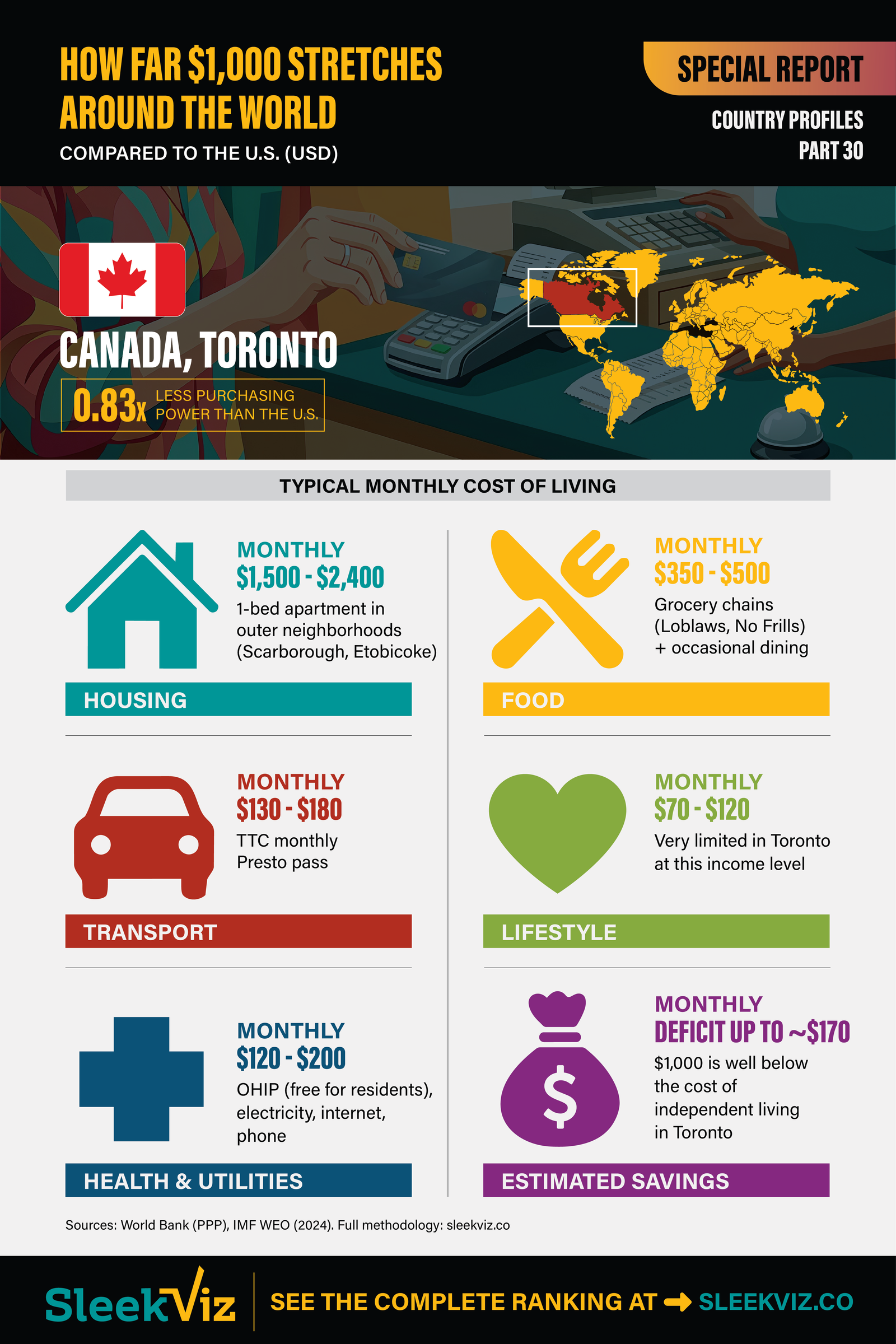
- $830 in Canada
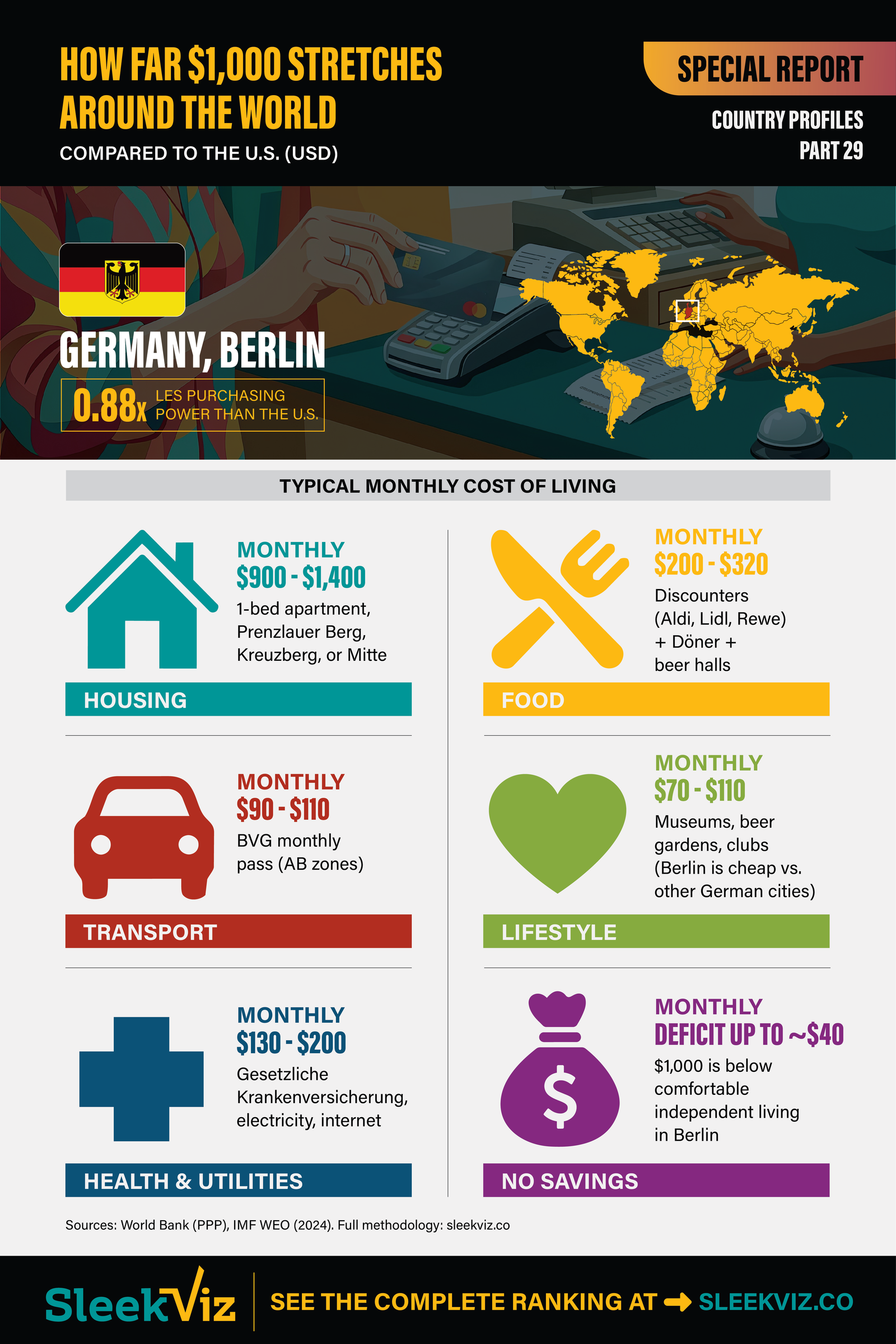
- $880 in Germany
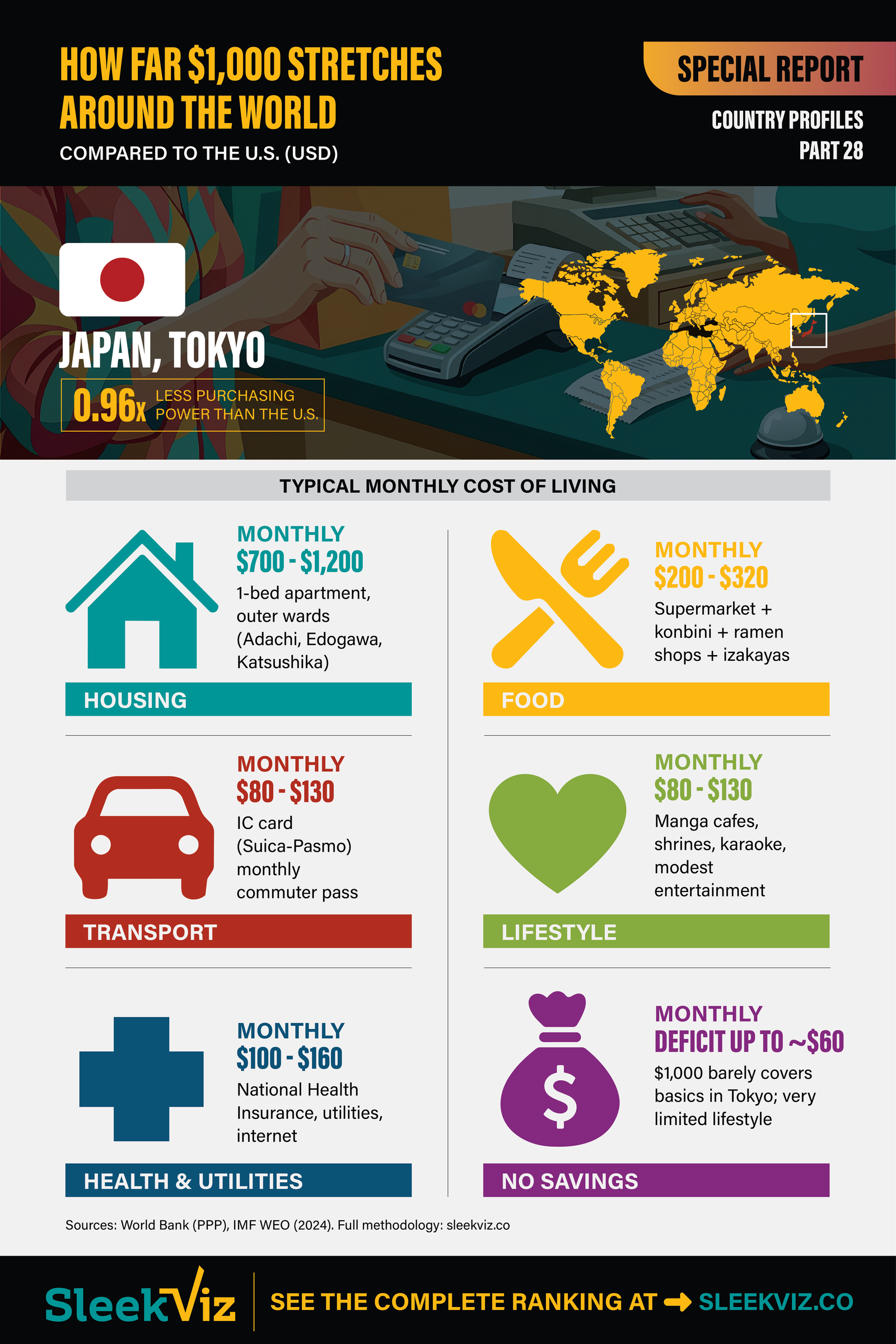
- $960 in Japan
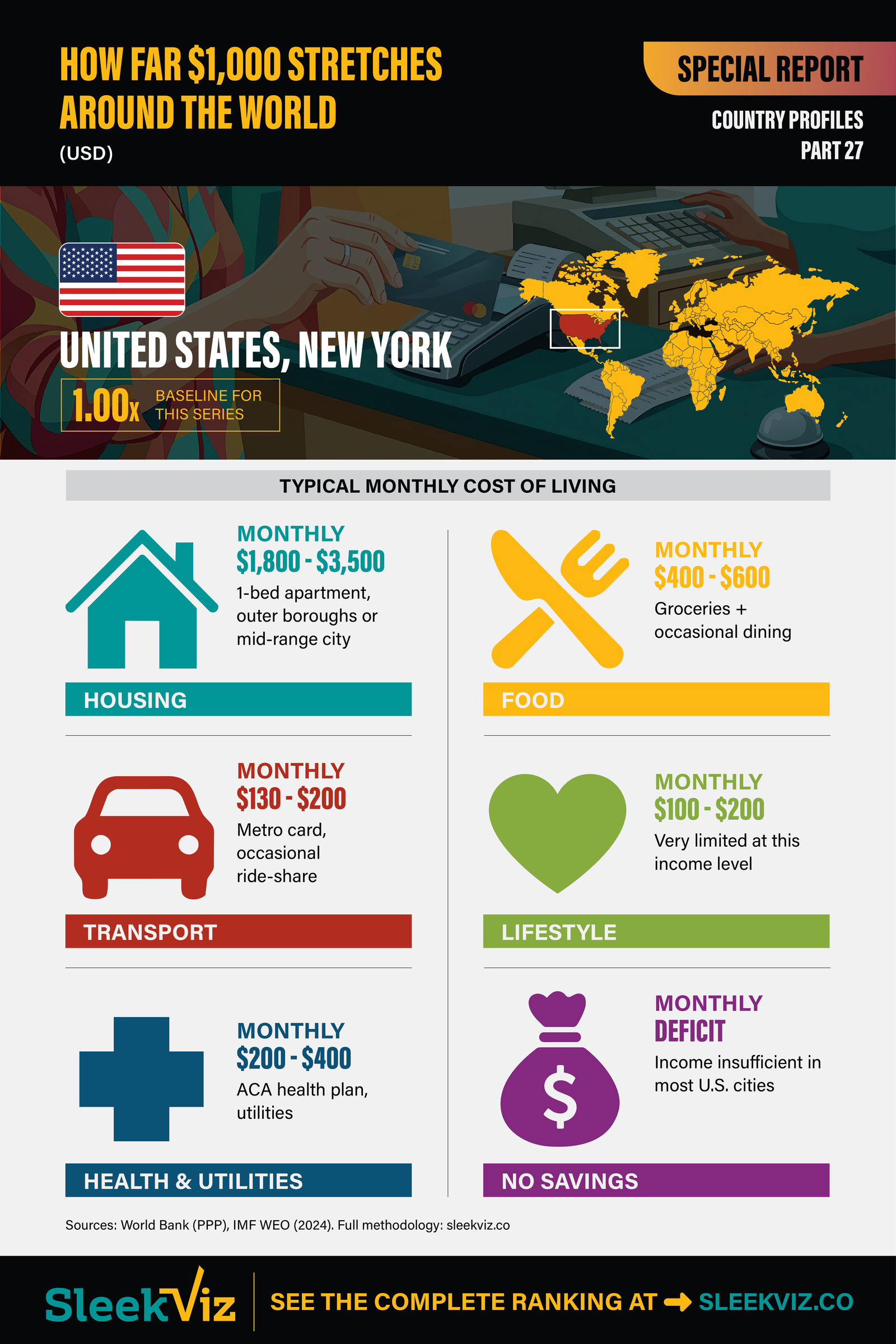
The U.S. serves as the baseline at $1,000.
These figures are not currency-exchange values. They are PPP-adjusted estimates designed to account for differences in the prices of goods and services between countries.
What Is Purchasing Power Parity?
Purchasing power parity, or PPP, is an economic method used to compare what money can actually buy in different countries. Exchange rates alone can be misleading. A currency may be worth less than the U.S. dollar on financial markets while local goods and services are also substantially cheaper. PPP attempts to account for those differences by comparing the cost of a similar basket of goods and services. For this analysis, the real purchasing power of $1,000 is calculated relative to the United States using the PPP conversion factor:
Real purchasing power = $1,000 × (U.S. PPP factor ÷ country PPP factor)
The U.S. baseline is 1.00. The analysis uses World Bank PPP data and IMF World Economic Outlook data, with wage comparisons based on international labor statistics.
$1,000 Around the World: 32-Country Comparison
The comparison covers 32 countries across Asia, Europe, Africa, North America, Latin America, the Middle East, and Oceania.
| COUNTRY | REAL PURCHASING POWER OF $1,000 | MULTIPLIER | TIER |
|---|---|---|---|
| Pakistan | ~$4,550 | 4.55× | Far Above Average |
| Bangladesh | ~$3,170 | 3.17× | Far Above Average |
| India | ~$2,960 | 2.96× | Above Average |
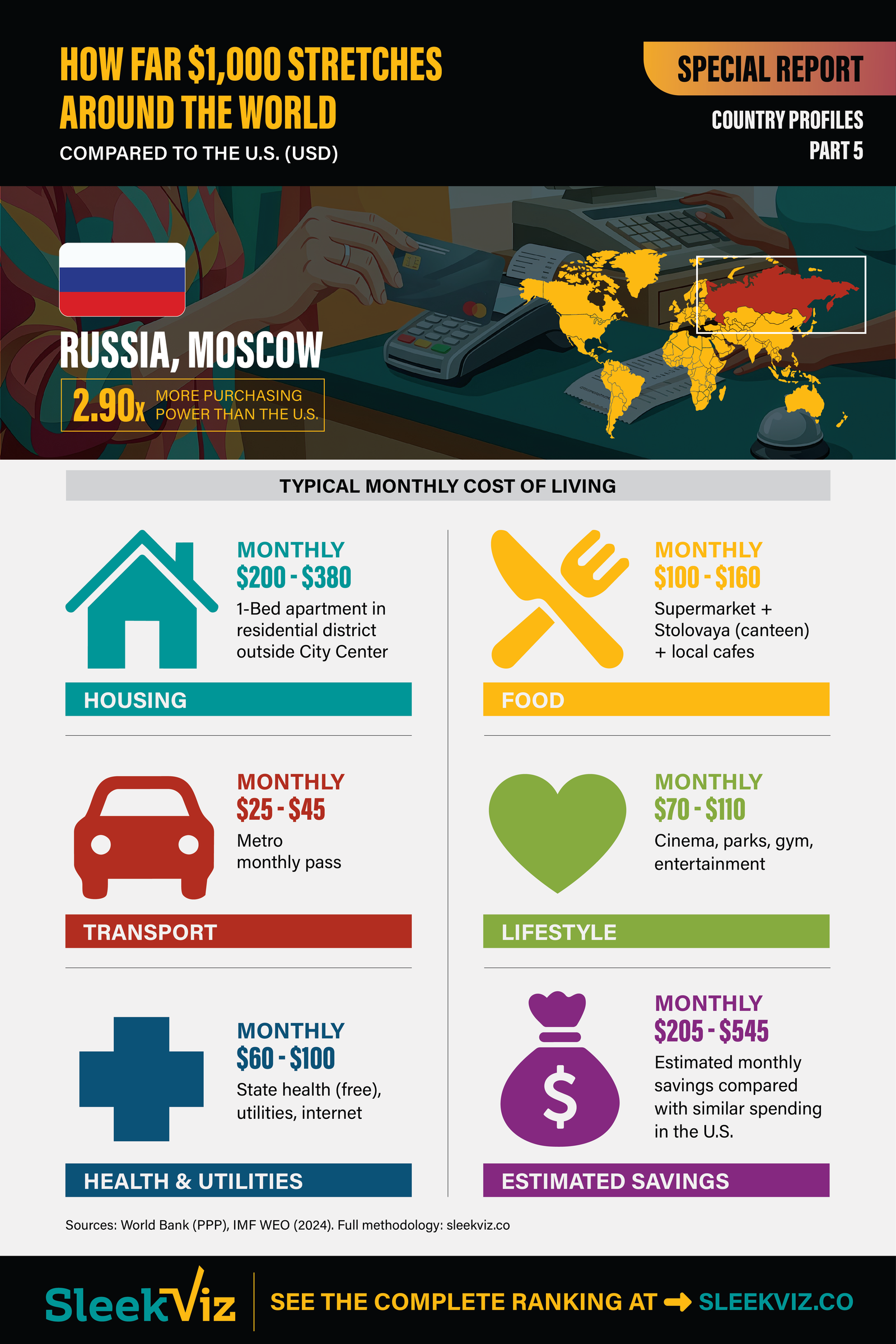
| Russia | ~$2,900 | 2.90× | Above Average |
| Egypt | ~$2,800 | 2.80× | Far Above Average |
| Philippines | ~$2,230 | 2.23× | Above Average |
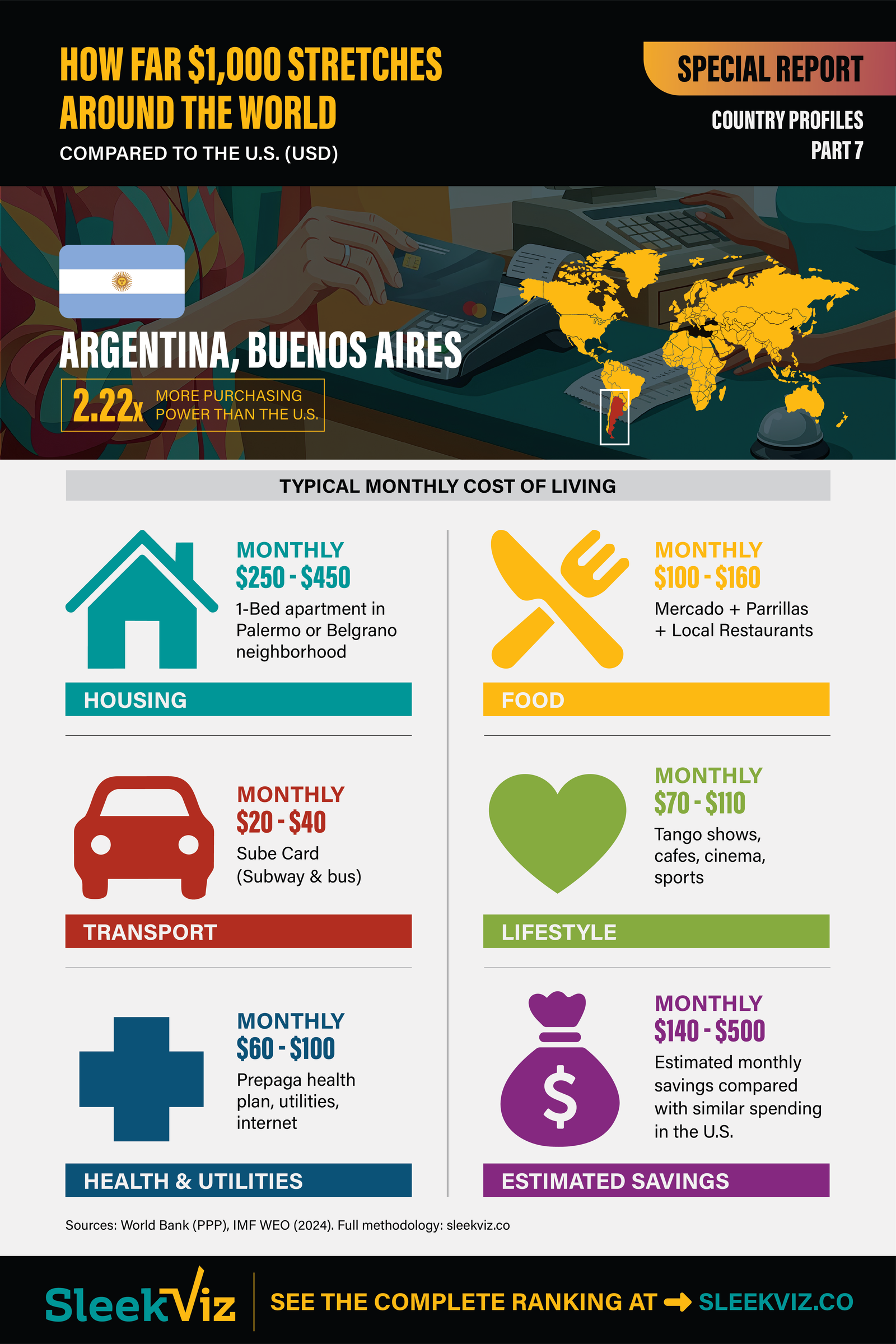
| Argentina | ~$2,220 | 2.22× | Above Average |
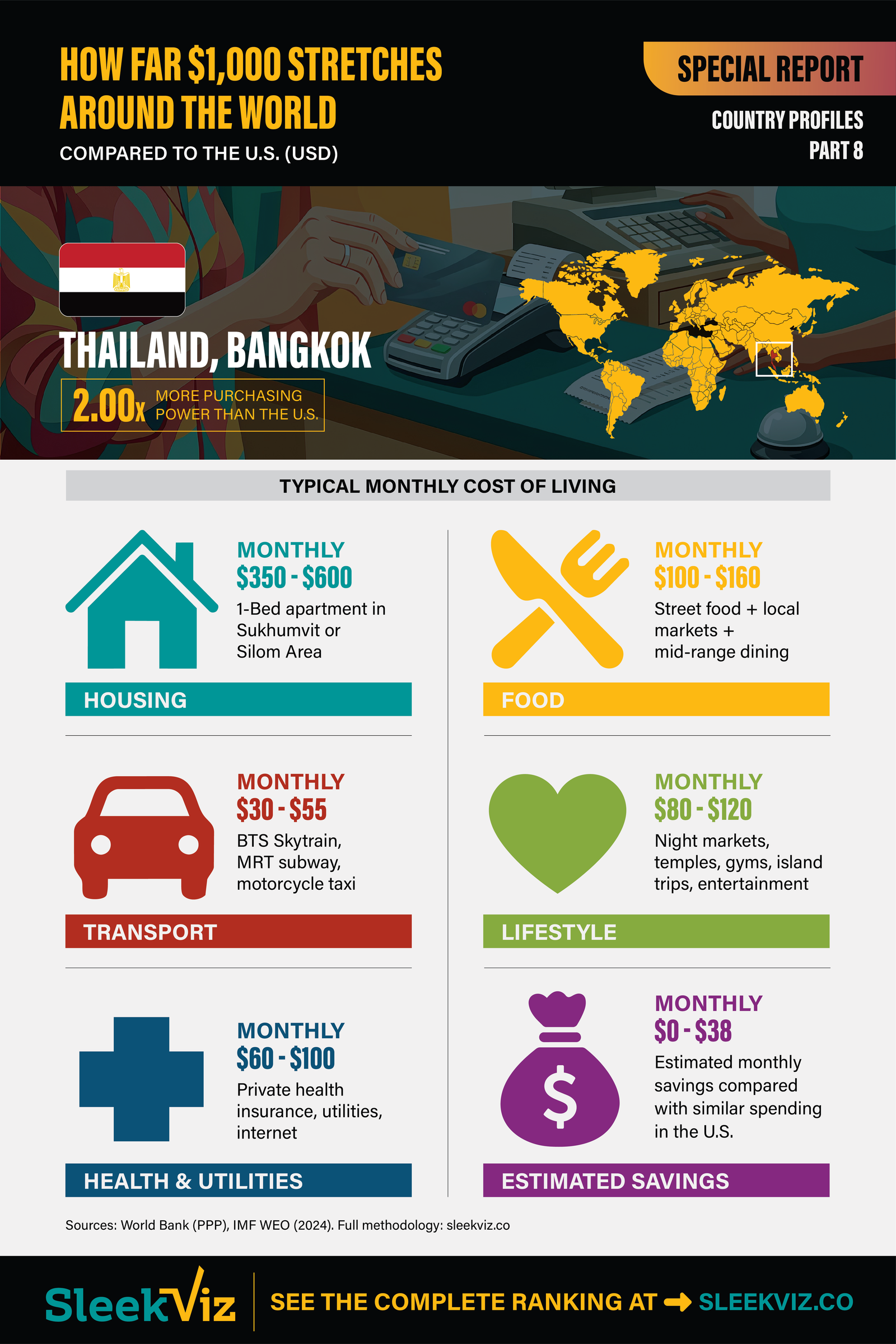
| Thailand | ~$2,000 | 2.00× | Above Average |
| Colombia | ~$1,950 | 1.95× | Above Average |
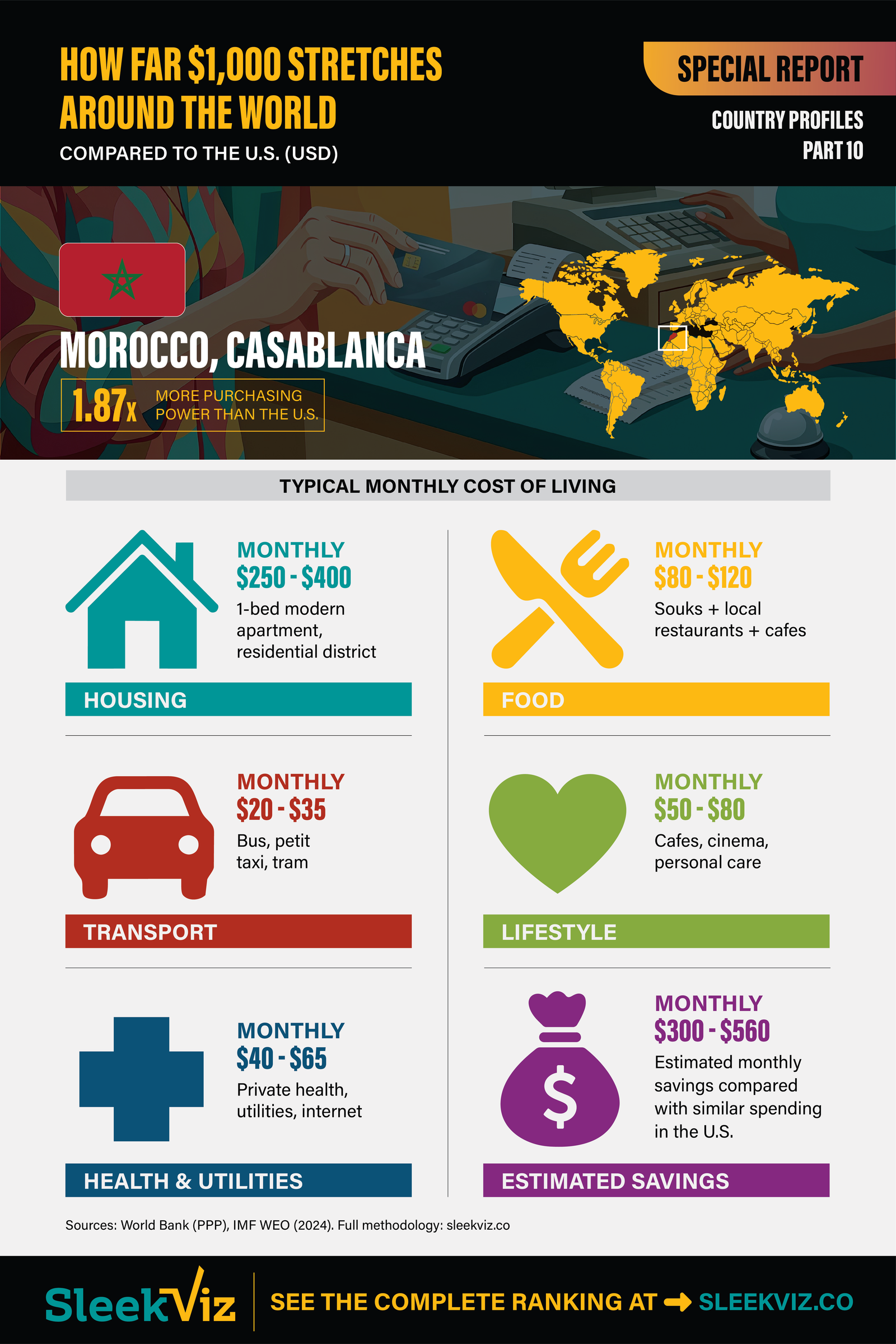
| Morocco | ~$1,870 | 1.87× | Above Average |
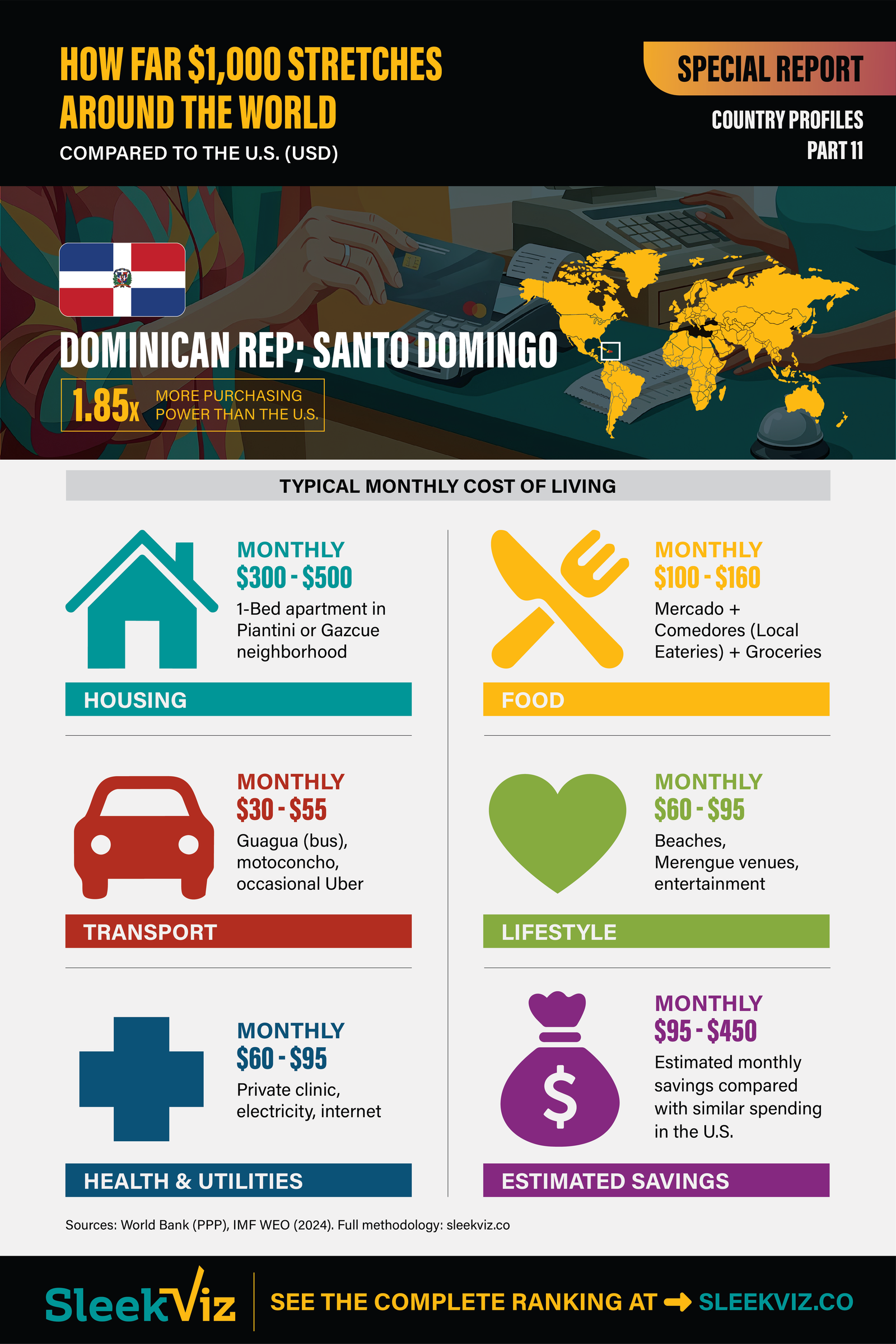
| Dominican Republic | ~$1,850 | 1.85× | Above Average |
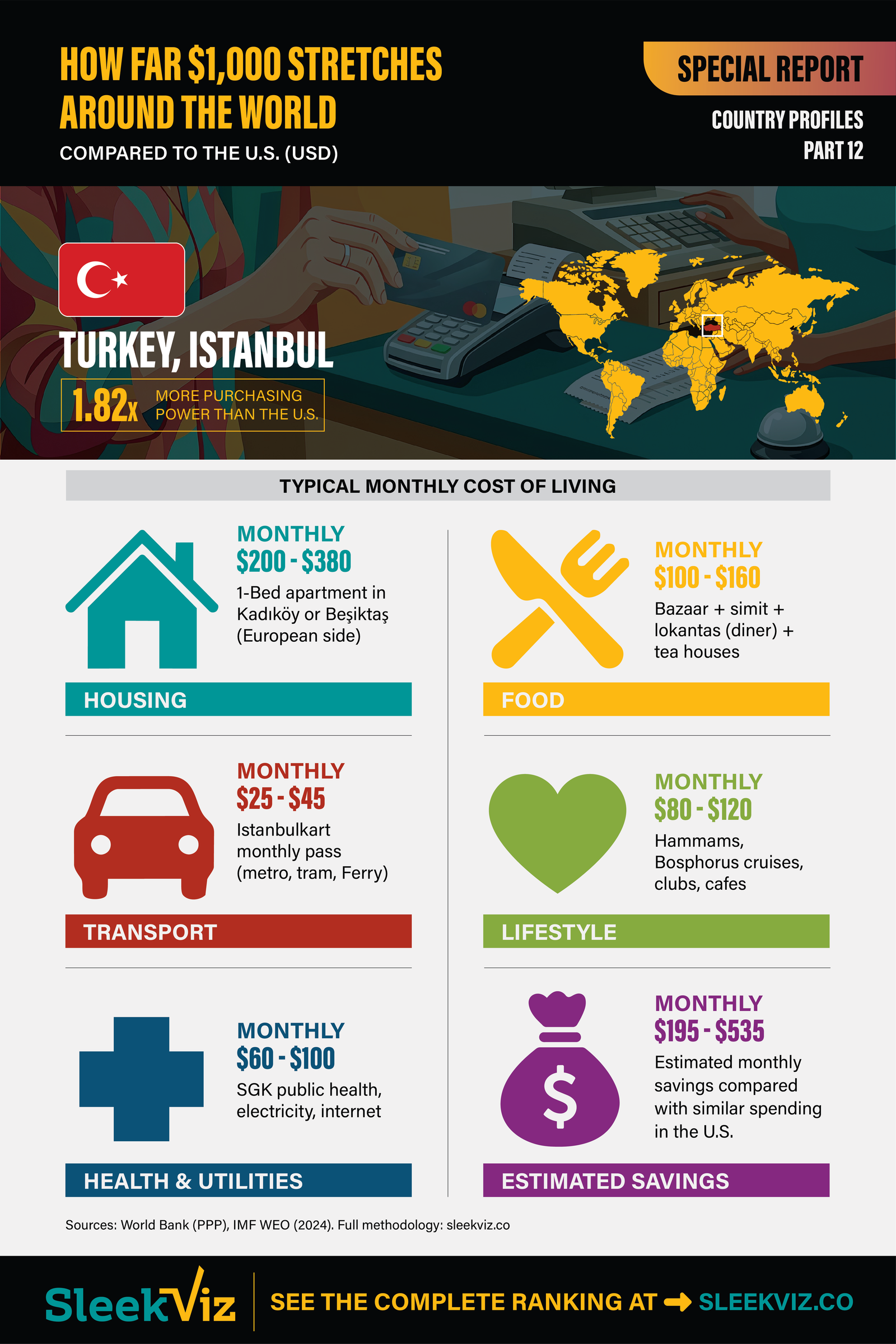
| Turkey | ~$1,820 | 1.82× | Above Average |
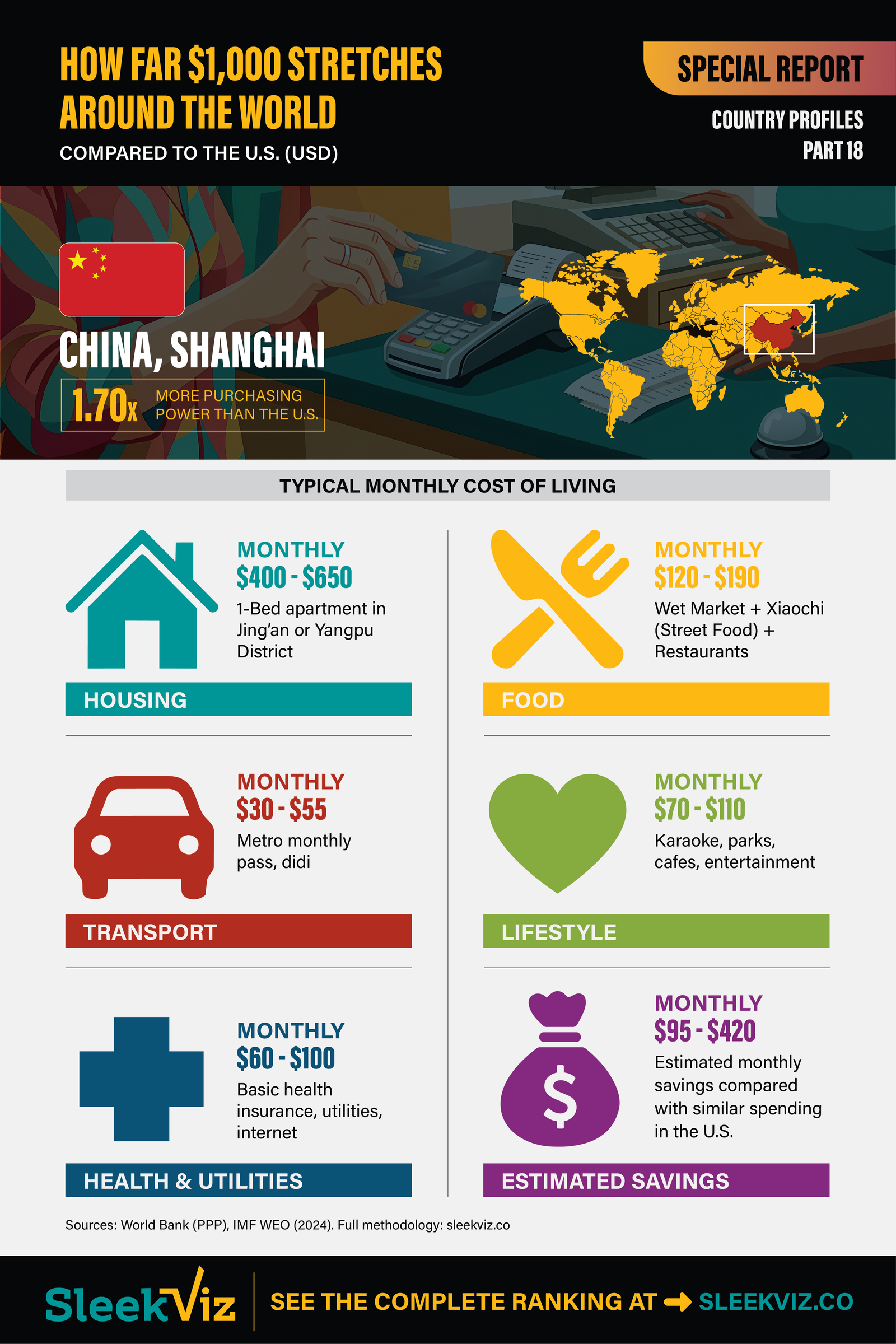
| China | ~$1,700 | 1.70× | At or Near Average |
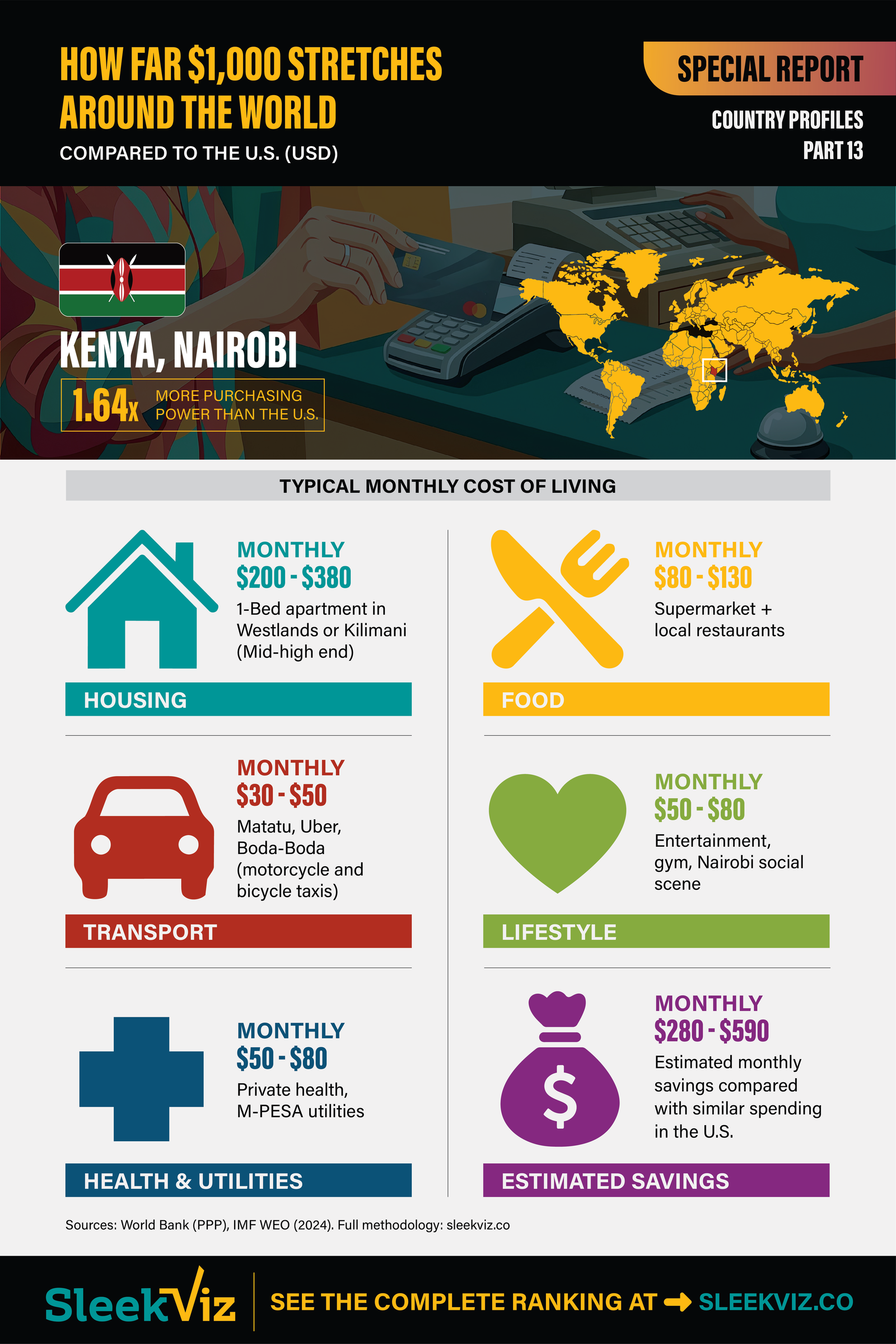
| Kenya | ~$1,640 | 1.64× | Above Average |
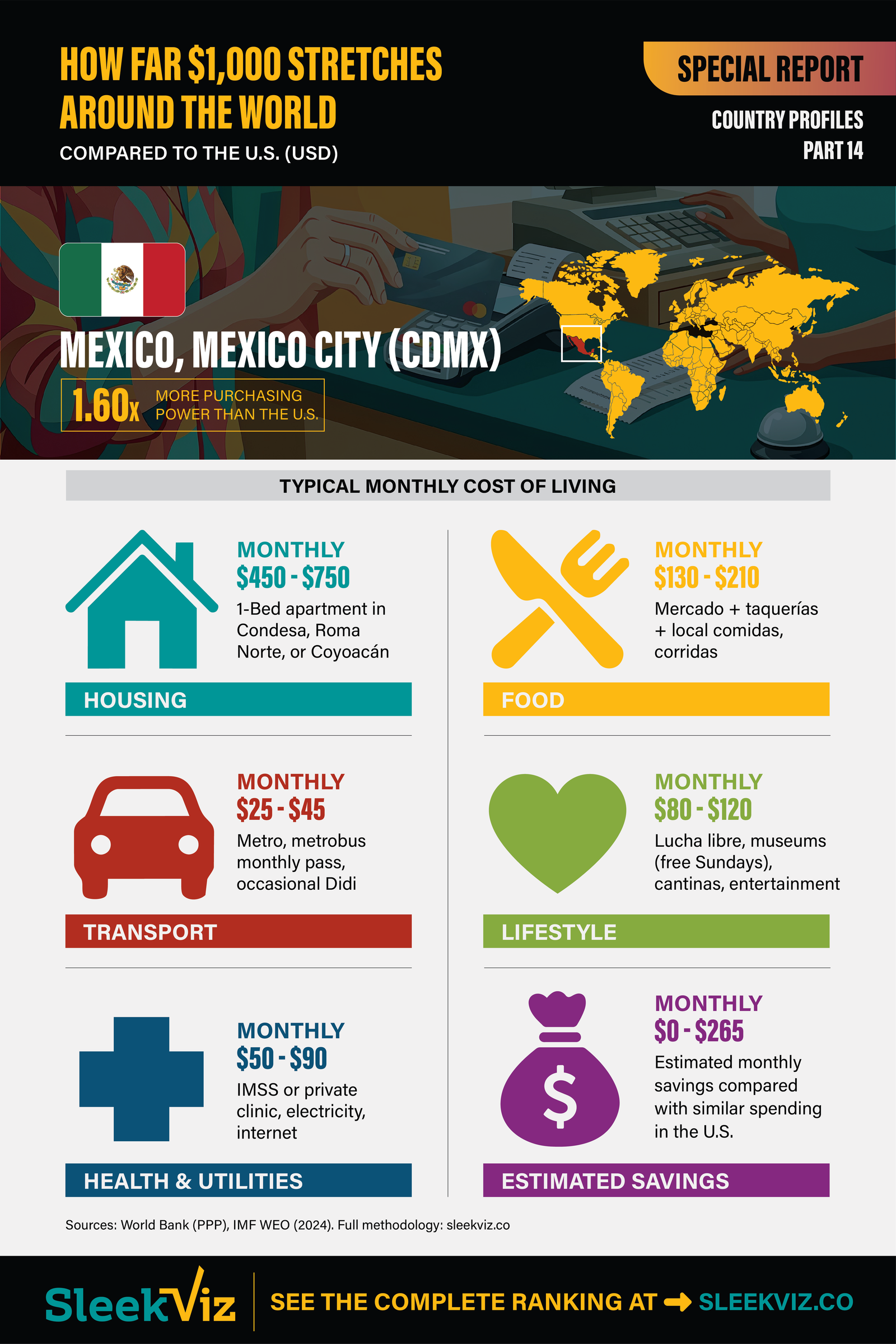
| Mexico | ~$1,600 | 1.60× | Above Average |
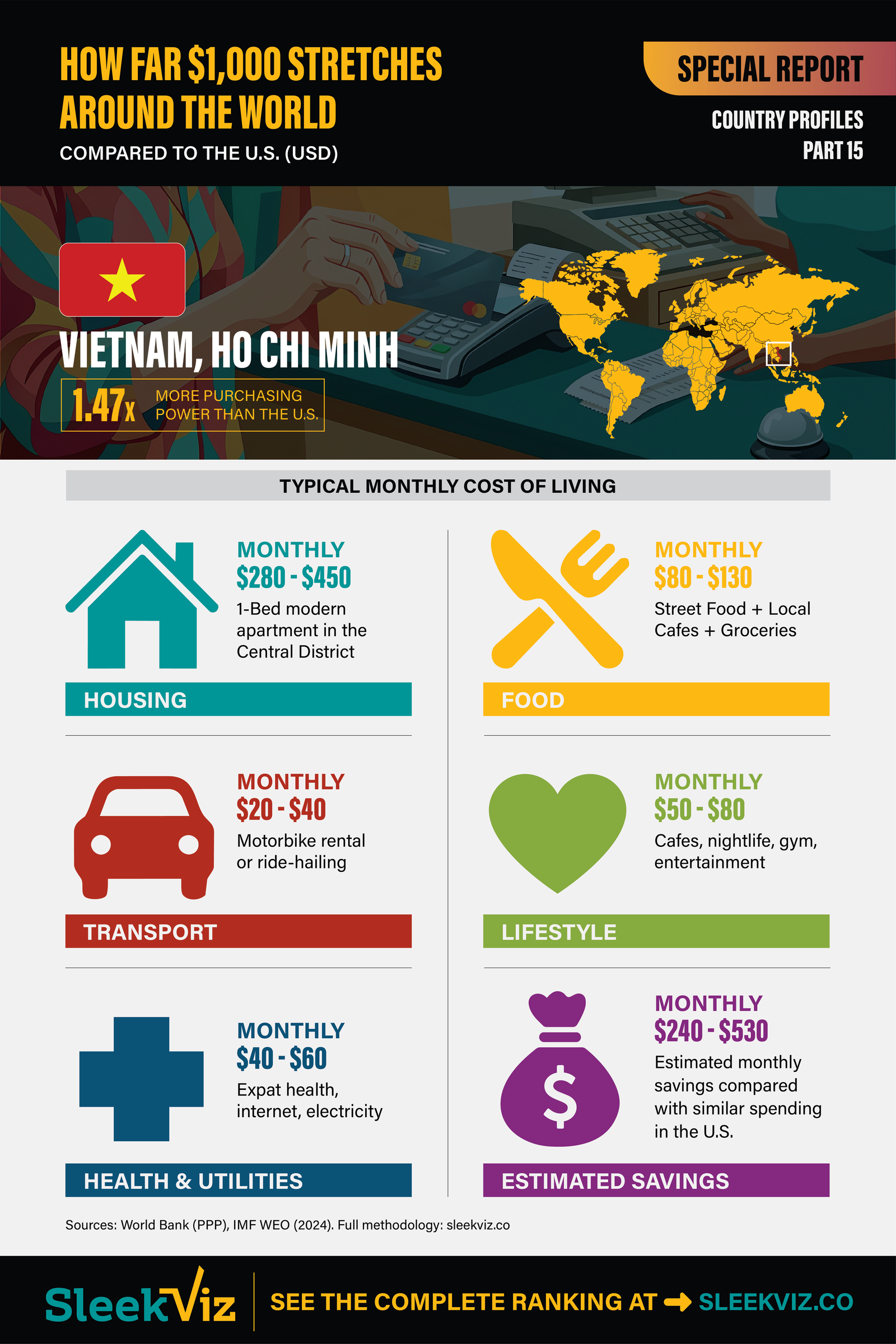
| Vietnam | ~$1,470 | 1.47× | Above Average |
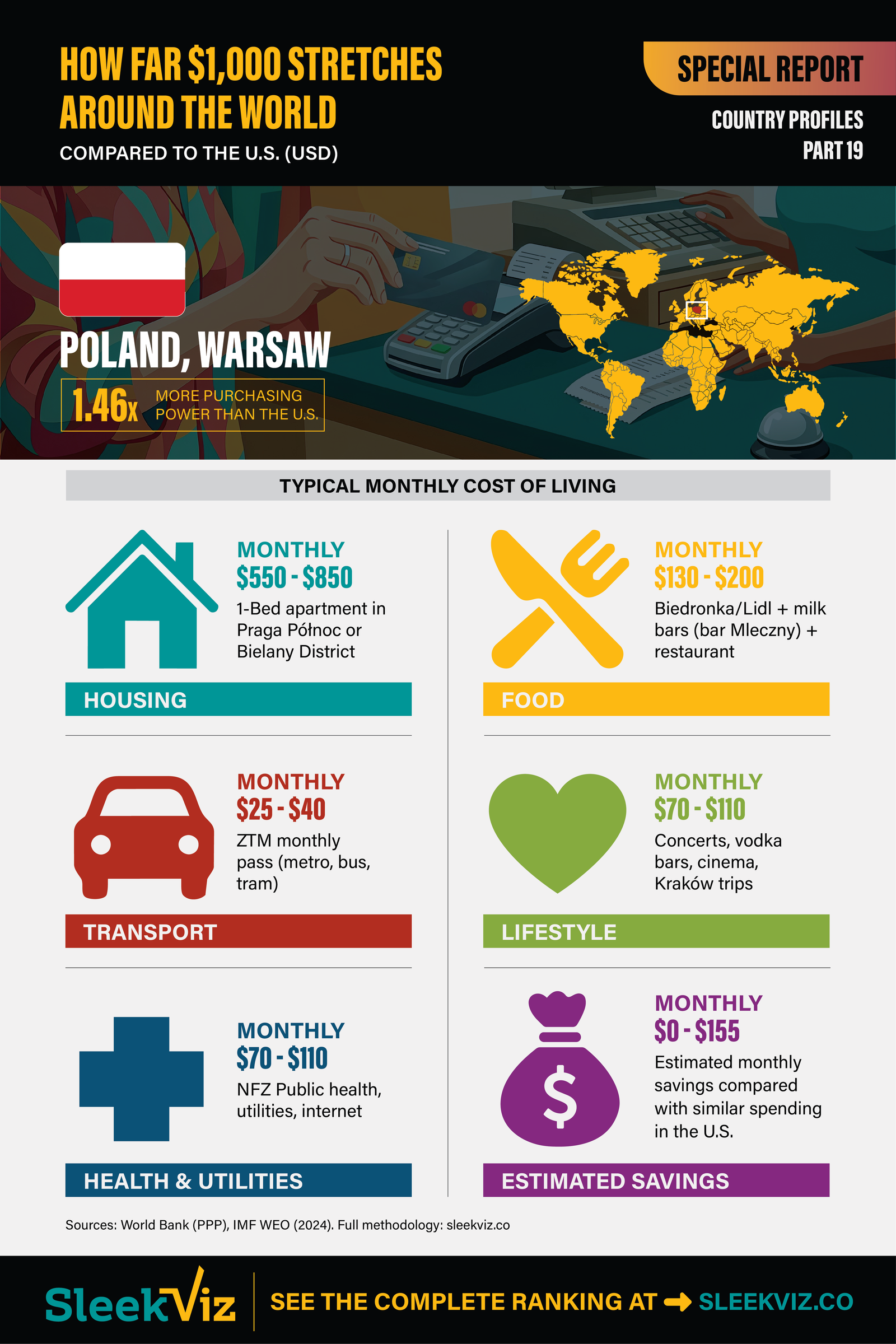
| Poland | ~$1,460 | 1.46× | At or Near Average |
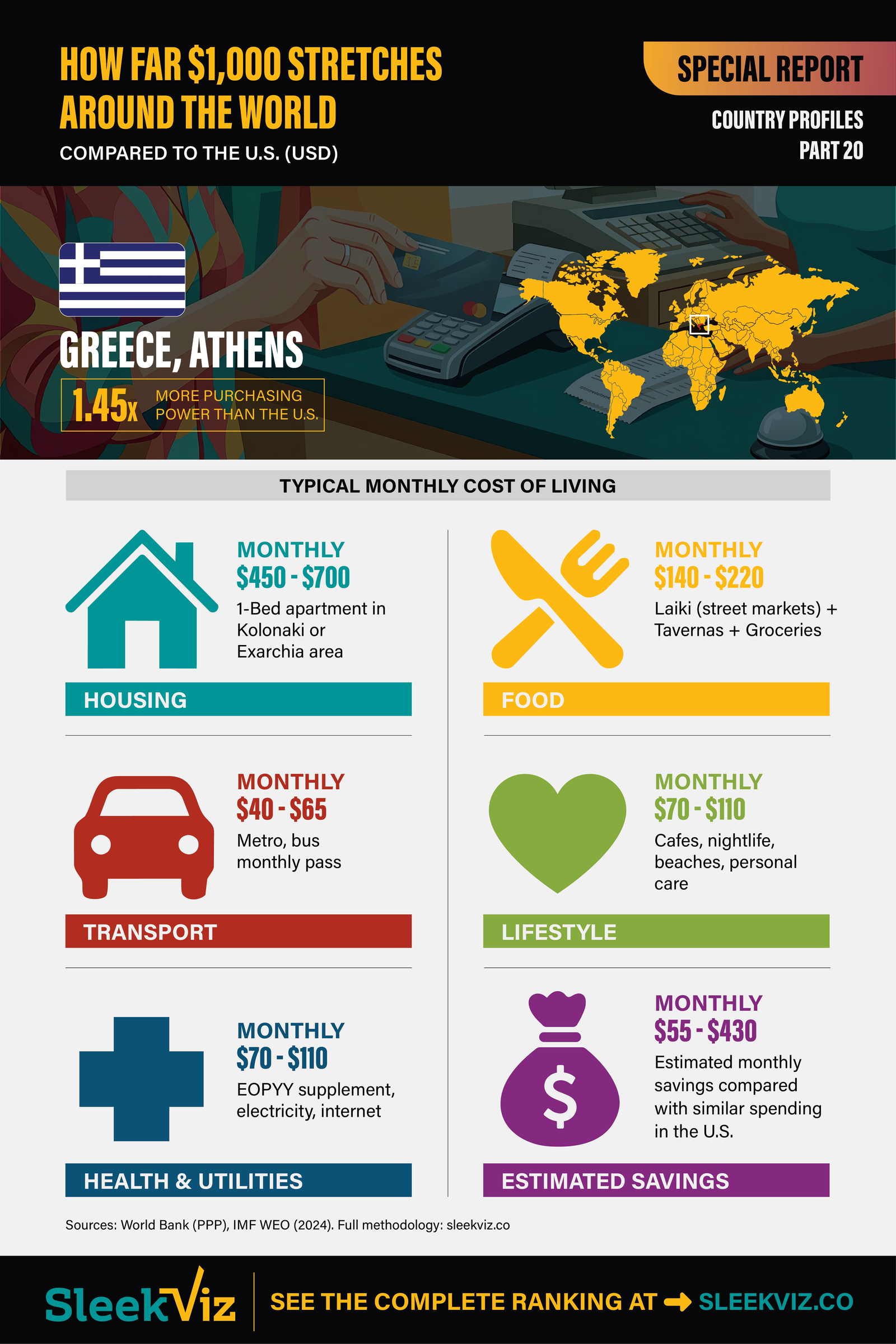
| Greece | ~$1,450 | 1.45× | At or Near Average |
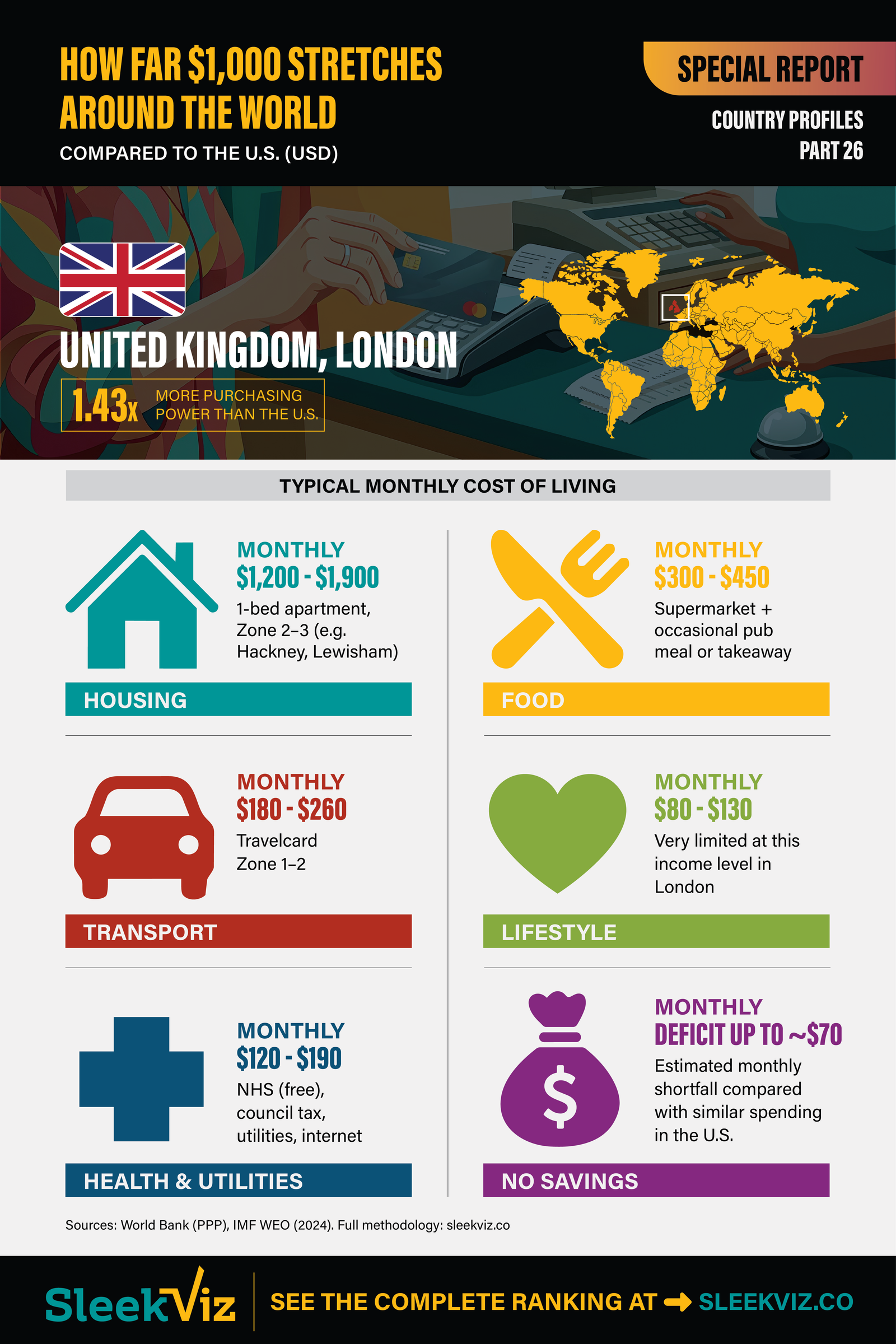
| United Kingdom | ~$1,430 | 1.43× | Below Average |
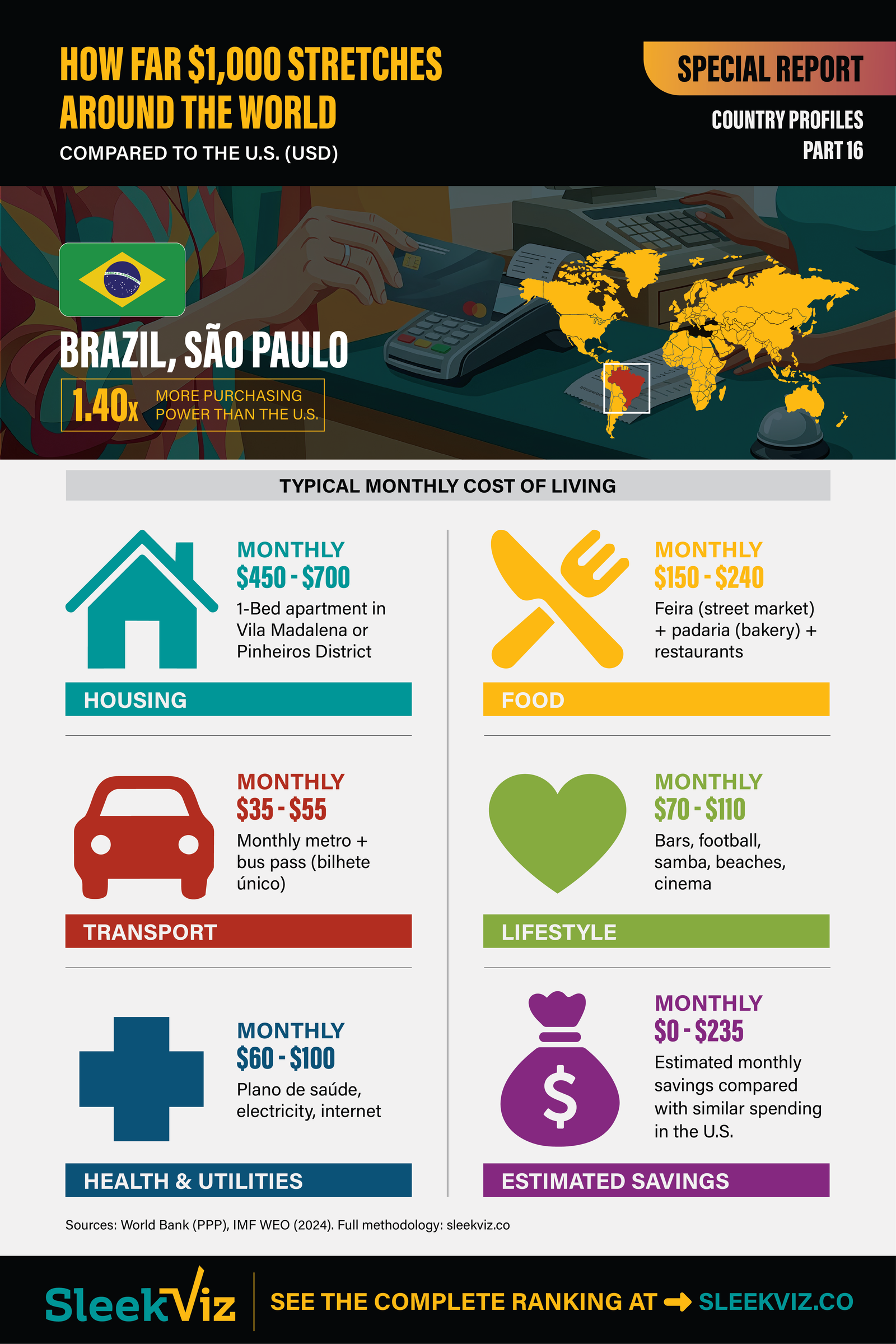
| Brazil | ~$1,400 | 1.40× | Above Average |
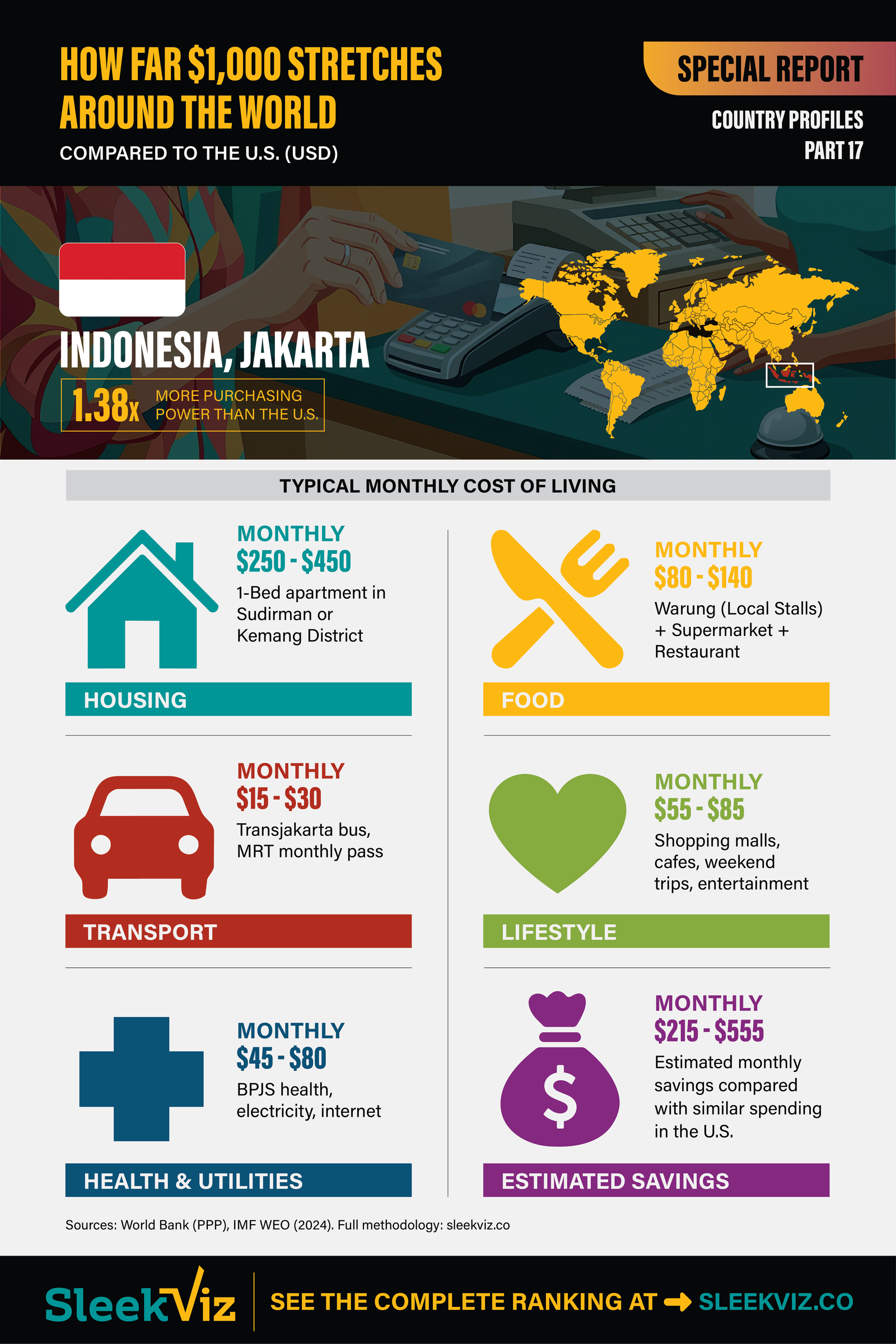
| Indonesia | ~$1,380 | 1.38× | Above Average |
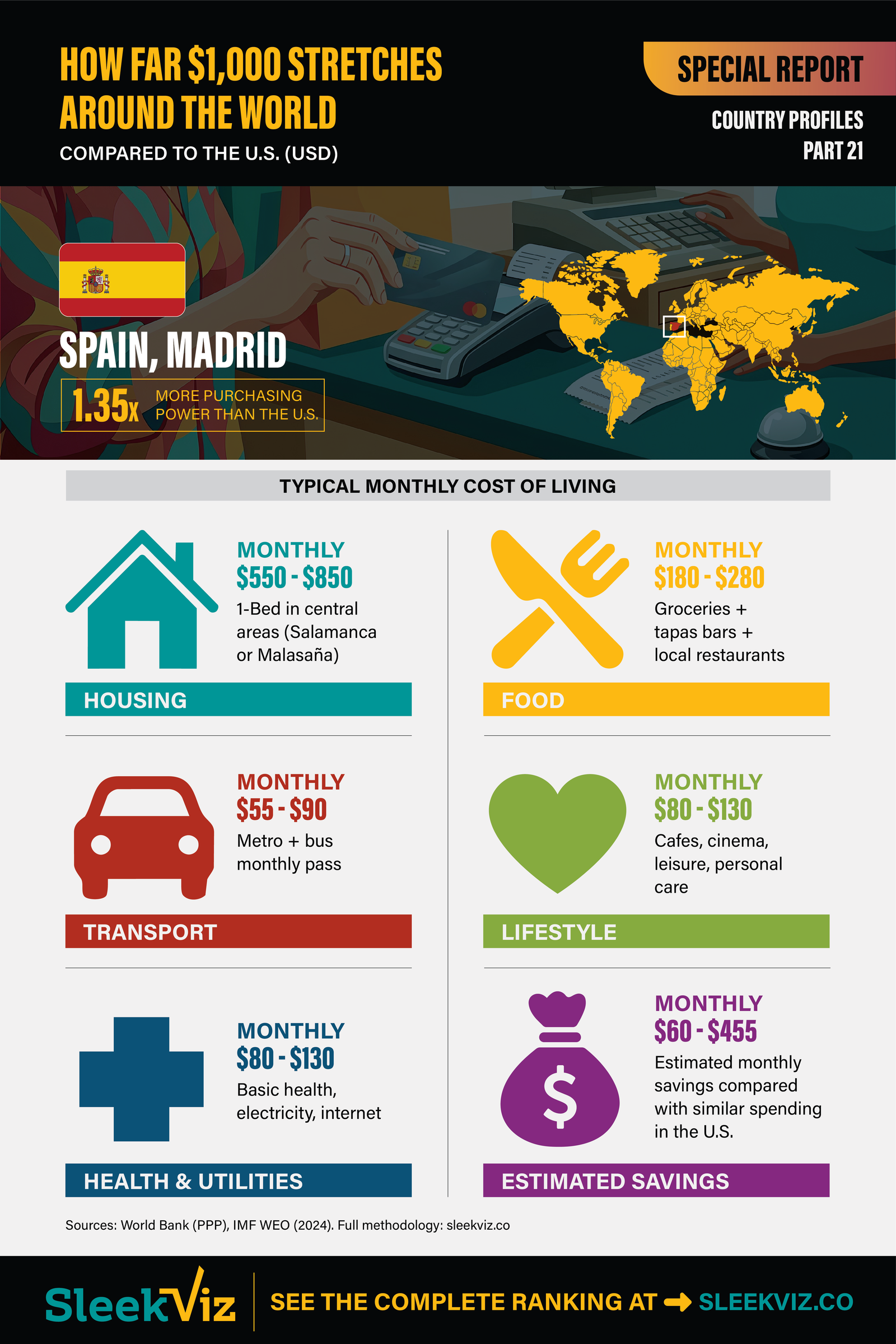
| Spain | ~$1,350 | 1.35× | At or Near Average |
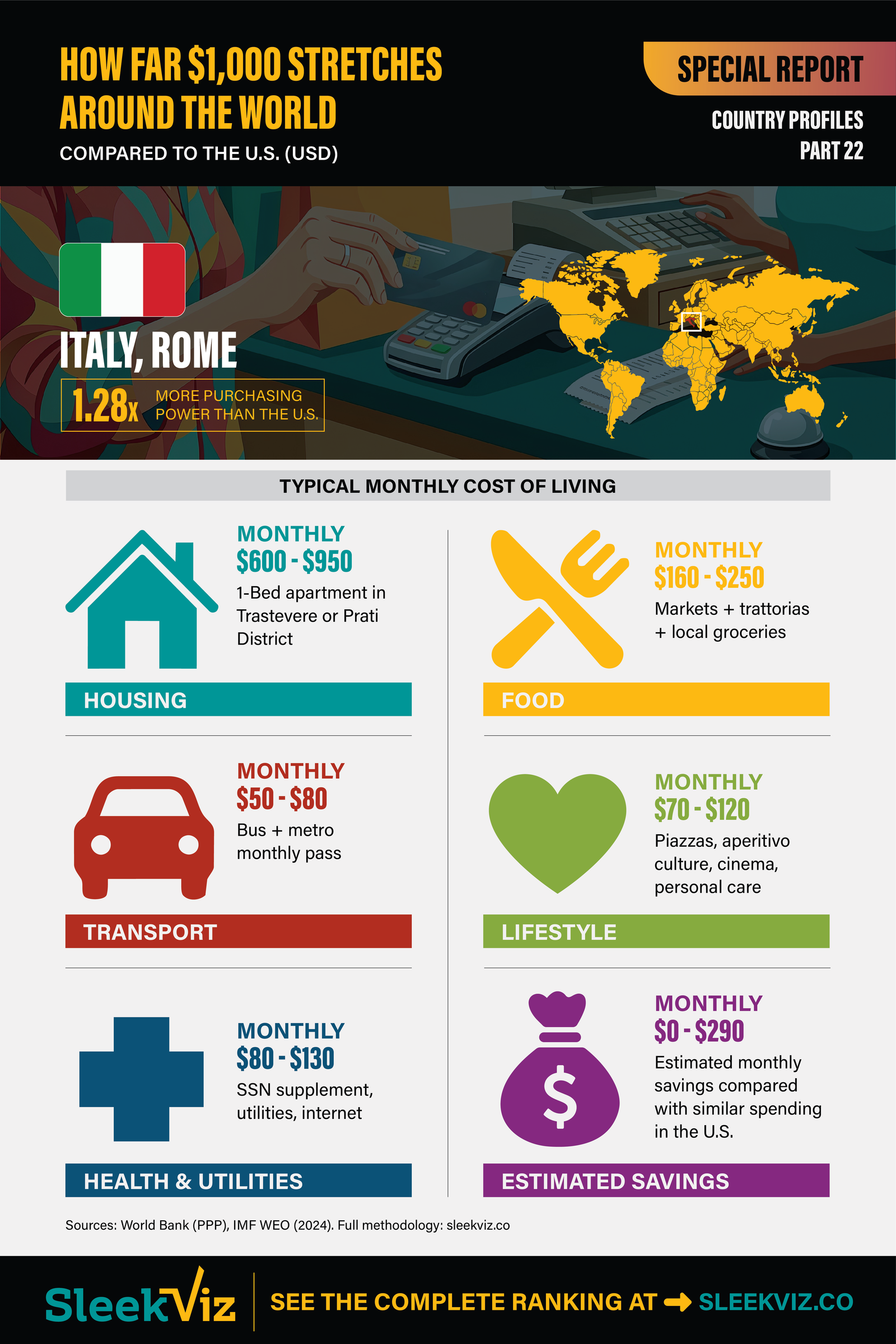
| Italy | ~$1,280 | 1.28× | At or Near Average |
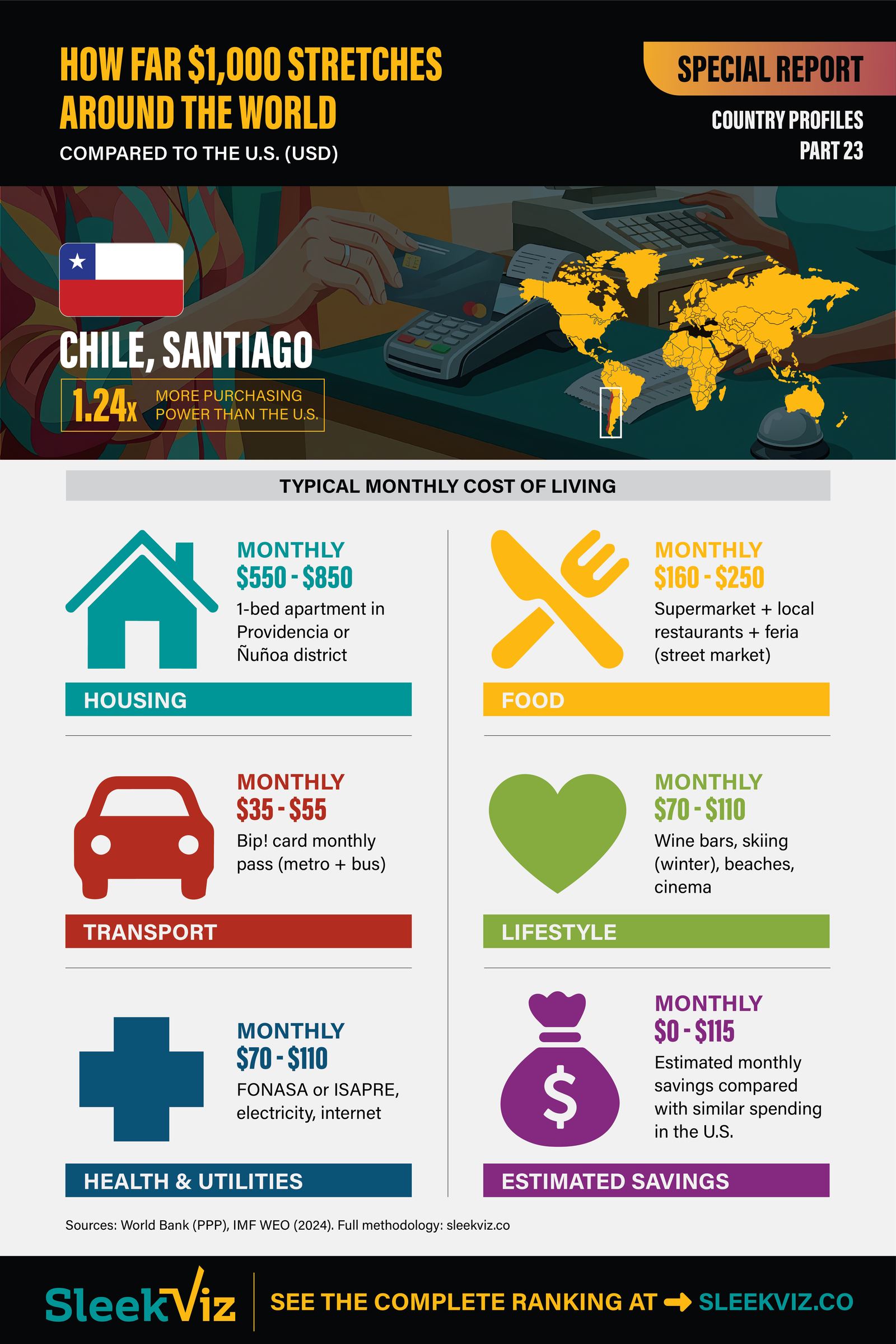
| Chile | ~$1,240 | 1.24× | At or Near Average |
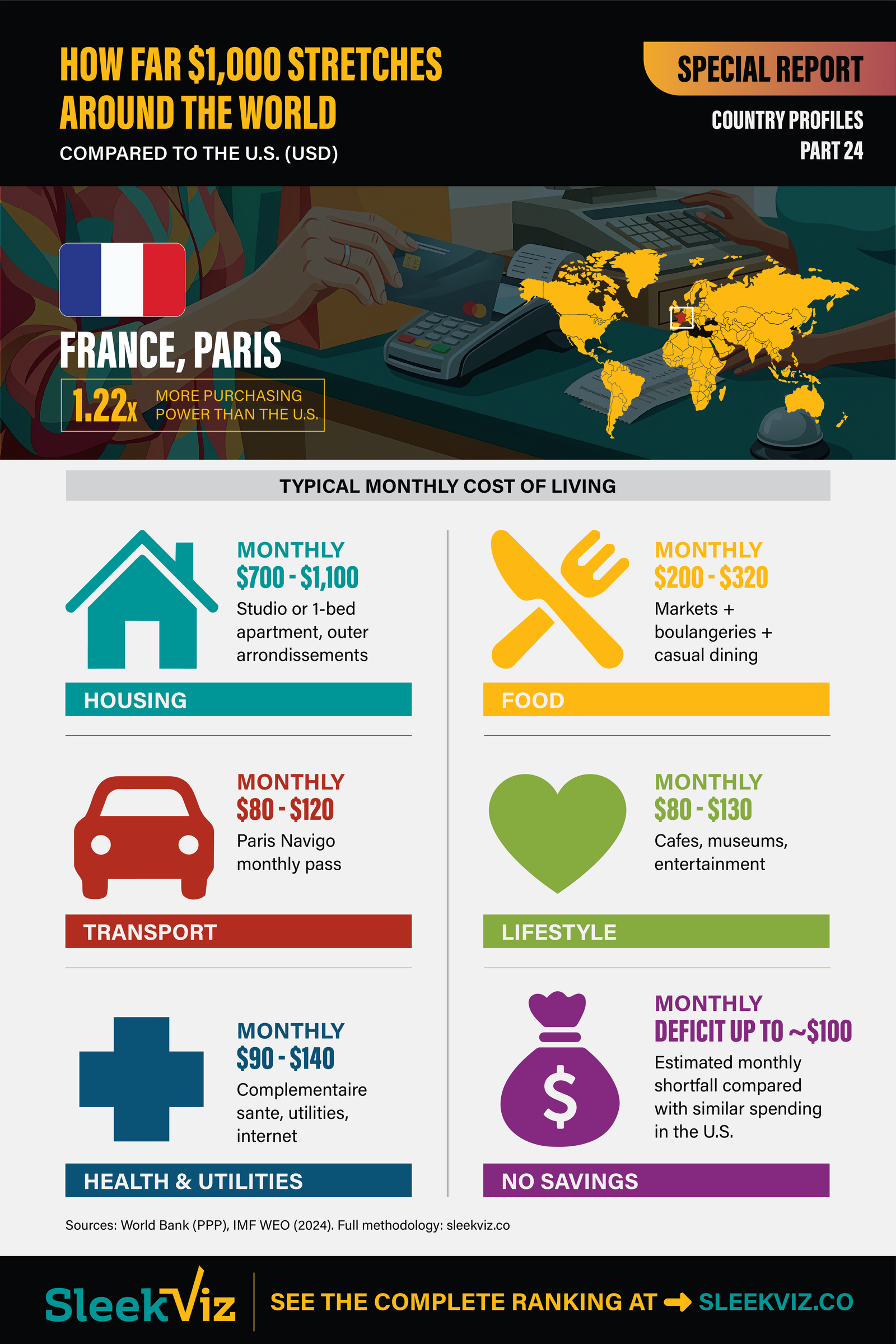
| France | ~$1,220 | 1.22× | At or Near Average |
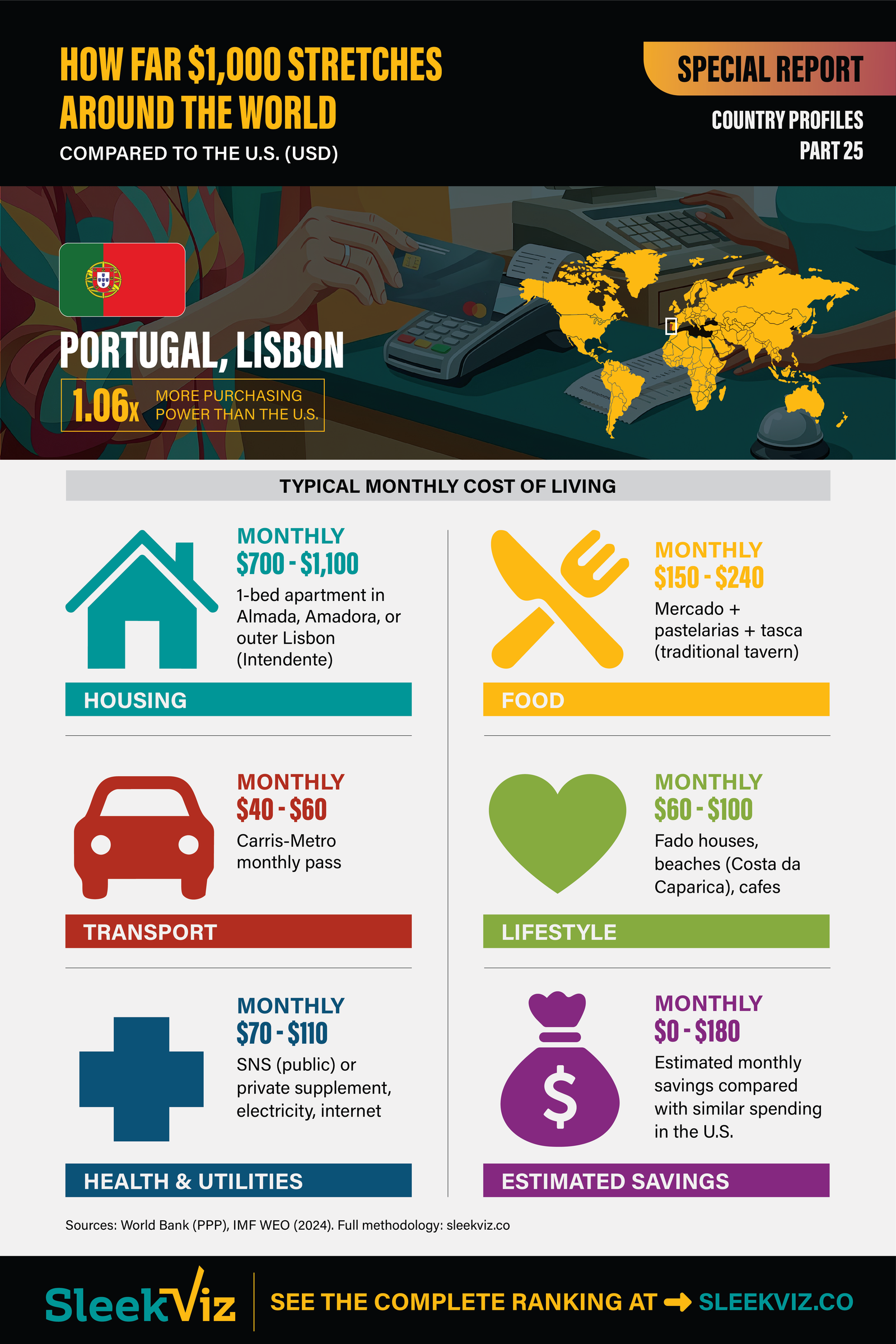
| Portugal | ~$1,060 | 1.06× | At or Near Average |
| United States | $1,000 | 1.00x | Below Average |
| Japan | ~$960 | 0.96× | Insufficient |
| Germany | ~$880 | 0.88× | Insufficient |
| Canada | ~$830 | 0.83× | Insufficient |
| Switzerland | ~$810 | 0.81× | Insufficient |
| Australia | ~$680 | 0.68× | Insufficient |
The underlying research uses standardized metrics across countries, including PPP factor, PPP-adjusted purchasing power, purchasing-power multiplier, share of monthly wages, and lifestyle tier.
The Five Purchasing-Power Tiers
To make the comparison easier to understand, the countries are grouped into five standardized tiers.
Tier 1 — Far Above Average
$1,000 is at least four times the local average wage.
In the dataset, Pakistan, Bangladesh, and Egypt fall into this category.
Tier 2 — Above Average
$1,000 represents roughly two to four times the local average wage.
Countries including India, the Philippines, Colombia, Mexico, Turkey, Morocco, Kenya, and Argentina fall into this group.
Tier 3 — At or Near Average
$1,000 represents approximately one to two times the local average wage.
Portugal, Poland, Spain, France, Italy, Greece, Chile, and China are examples.
Tier 4 — Below Average
$1,000 falls below the local average wage and generally requires a more modest lifestyle.
The United States and United Kingdom fall into this category in the comparison.
Tier 5 — Insufficient
At local prices, $1,000 is not enough to comfortably support independent living.
Japan, Germany, Switzerland, Canada, and Australia fall into this group.
What Can $1,000 Buy in Different Cities?
Country averages don’t tell the whole story.
The cost of living can vary enormously within the same country, particularly between major cities and smaller urban areas.
For example, the analysis uses specific reference cities to illustrate how $1,000 can be allocated across everyday expenses such as housing, food, transportation, health, utilities, lifestyle spending, and savings.
Dhaka, Bangladesh
A $1,000 monthly income can provide substantial room after basic expenses.
The estimated budget includes approximately $80–$140 for housing, $60–$100 for food, $15–$25 for transportation, and $30–$55 for health and utilities.
Under the modeled budget, estimated monthly savings could reach approximately $620–$780.
Manila, Philippines
Housing is considerably more expensive than in Dhaka, particularly in areas such as Makati and BGC.
The estimated housing budget is $250–$450, with food at approximately $100–$160 and transportation at $30–$55.
Depending on spending, the model estimates potential savings of approximately $145–$500 per month.
Tokyo, Japan
The picture changes dramatically in Tokyo.
Estimated housing alone ranges from $700–$1,200 for a one-bedroom apartment in outer wards. Food, transportation, health insurance, utilities, and other expenses can push a $1,000 monthly budget to its limit.
The analysis therefore classifies $1,000 as insufficient for comfortable independent living in Tokyo.
New York, United States
New York provides another stark contrast.
A one-bedroom apartment can consume $1,800–$3,500 per month in the reference scenario, before food, transportation, healthcare, utilities, or other expenses.
Under the modeled budget, $1,000 produces a significant monthly deficit.
This illustrates the central point of the comparison: a $1,000 income doesn’t have a universal standard of living.
Why $1,000 Can Feel So Different
There are two important forces behind the differences: prices and local incomes.
In lower-cost economies, housing, transportation, food, and many services can require a much smaller share of $1,000.
But purchasing power should not be confused with wealth.
A country can have lower prices while also having substantially lower wages. A person earning $1,000 locally may therefore have a very different economic position from someone earning $1,000 abroad.
That’s why this analysis looks at both PPP-adjusted purchasing power and the share of local monthly wages represented by $1,000.
For example, the research estimates that $1,000 represents roughly 570% of Pakistan’s median monthly wage, compared with about 21% of the U.S. median individual wage.
PPP Has Limits
PPP is useful for comparing purchasing power across countries, but it does not tell you exactly what your personal life would cost.
Actual expenses depend on factors such as:
- The city you live in
- Housing location and size
- Healthcare needs
- Transportation choices
- Dining and entertainment habits
- Taxes
- Imported goods
- Exchange-rate fluctuations
- Whether you earn your income locally or remotely
For this reason, the figures in this analysis should be viewed as comparative estimates rather than personal financial advice or a guaranteed monthly budget.
Some countries also experience rapid inflation or currency volatility, which can make real-world purchasing power change faster than official PPP statistics.
The Bigger Picture
The most important takeaway isn’t simply that $1,000 goes further in one country than another.
It’s that income and purchasing power are not the same thing.
Two people can earn the same nominal amount of money while living completely different financial lives because the prices around them are different.
That’s why looking only at salary can give an incomplete picture of economic well-being.
A $1,000 monthly income may be insufficient for independent living in some of the world’s most expensive cities, while the same nominal income can provide substantial savings potential in lower-cost countries.
The number on your paycheck matters. But where you spend it matters too.
Methodology & Sources
This analysis uses Purchasing Power Parity data from the World Bank International Comparison Program (ICP) and the IMF World Economic Outlook, with wage comparisons based on international labor statistics.
The PPP conversion factor used in the research is the World Bank’s Private Consumption PPP Conversion Factor (PA.NUS.PRVT.PP). The research uses World Bank ICP 2021 data and IMF WEO data for the comparison.
All purchasing-power and budget figures are approximate and intended for comparative and illustrative purposes.
Sources:
[1] World Bank — PPP Conversion Factor, Private Consumption (PA.NUS.PRVT.PP) https://data.worldbank.org/indicator/PA.NUS.PRVT.PP
[2] World Bank — GDP per Capita, PPP (NY.GDP.PCAP.PP.CD) https://data.worldbank.org/indicator/NY.GDP.PCAP.PP.CD
[3] IMF — World Economic Outlook Database (PPP Conversion Rates, Oct 2024) https://www.imf.org/en/Publications/WEO/weo-database/2024/October
[4] IMF — WEO Frequently Asked Questions: Methodology on PPP Implied Conversion Rate https://www.imf.org/en/Publications/WEO/frequently-asked-questions
[5] IMF — Explainer: Purchasing Power Parity: Weights Matter https://www.imf.org/external/pubs/ft/fandd/basics/44-purchasing-power-parity.htm
[6] ILO — Global Wage Report 2024–25 https://www.ilo.org/global/research/global-reports/global-wage-report/lang–en/index.htm
[7] World Bank ICP — International Comparison Program 2021 Results (May 2024) https://www.worldbank.org/en/programs/icp/data
[8] Our World in Data — PPP Conversion Factor for Private Consumption (visualization) https://ourworldindata.org/grapher/ppp-conversion-factor-for-private-consumption
[9] World Population Review — Purchasing Power Parity by Country 2025 https://worldpopulationreview.com/country-rankings/purchasing-power-parity-by-country
[10] U.S. Bureau of Labor Statistics — Median Weekly Earnings Q3 2024 https://www.bls.gov/news.release/wkyeng.t01.htm